people to get from place to place. as horace dediu, a tech industry analyst said, \the car created the…
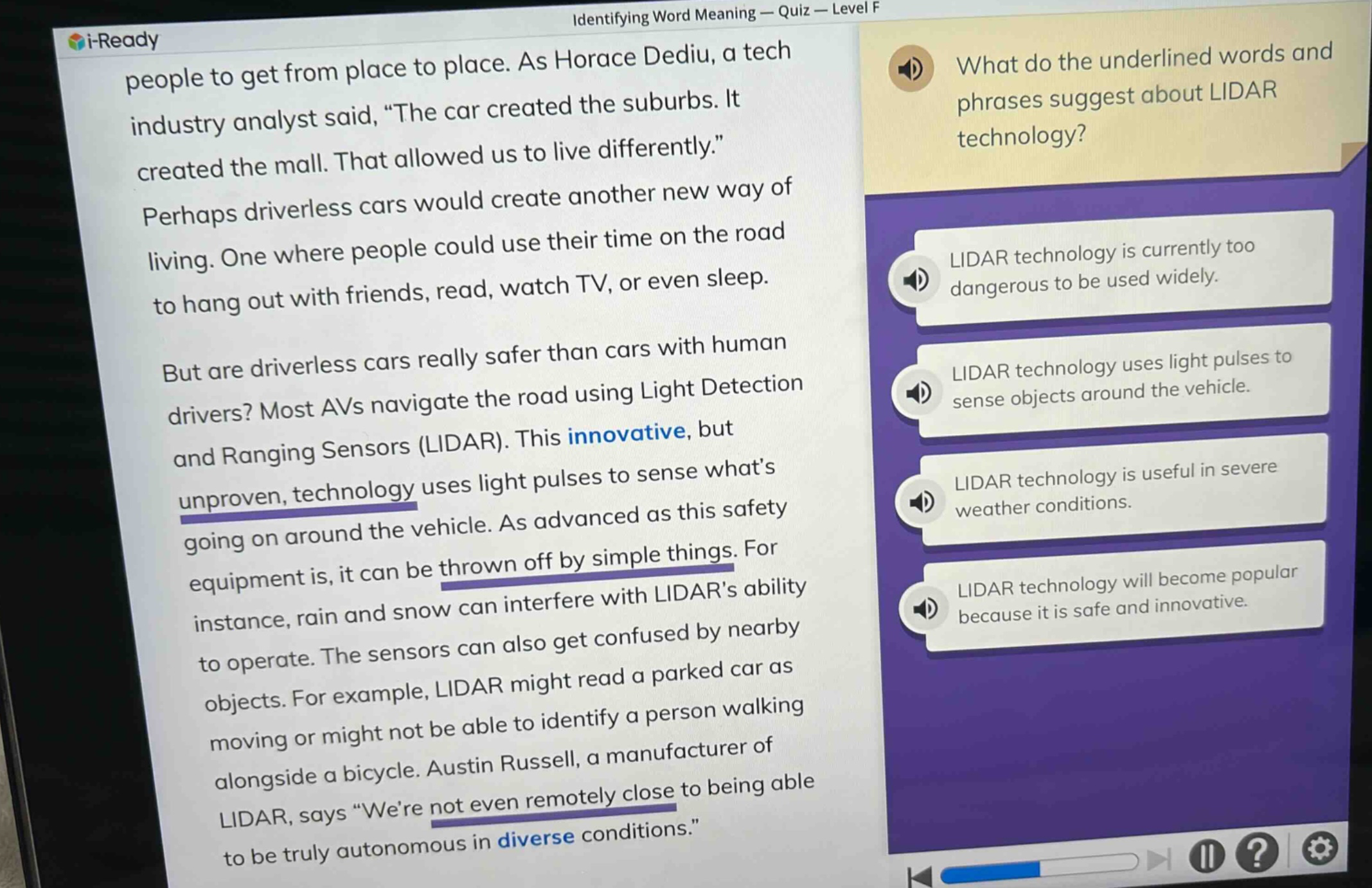
people to get from place to place. as horace dediu, a tech industry analyst said, \the car created the suburbs. it created the mall. that allowed us to live differently.\ perhaps driverless cars would create another new way of living. one where people could use their time on the road to hang out with friends, read, watch tv, or even sleep. but are driverless cars really safer than cars with human drivers? most avs navigate the road using light detection and ranging sensors (lidar). this innovative, but unproven, technology uses light pulses to sense whats going on around the vehicle. as advanced as this safety equipment is, it can be thrown off by simple things. for instance, rain and snow can interfere with lidars ability to operate. the sensors can also get confused by nearby objects. for example, lidar might read a parked car as moving or might not be able to identify a person walking alongside a bicycle. austin russell, a manufacturer of lidar, says \were not even remotely close to being able to be truly autonomous in diverse conditions.\
Answer
Brief Explanations:
The text states that LIDAR is an "innovative, but unproven, technology" and gives examples like being "thrown off by simple things" (e.g., rain, snow, nearby objects). It also mentions that "we're not even remotely close to being able to be truly autonomous in diverse conditions". These details show that LIDAR has limitations and issues, meaning it's not yet reliable enough for wide - scale use, which implies it's currently too dangerous (in the sense of not being fully tested and having flaws) for widespread application. The other options are incorrect:
- There is no indication in the text that it "uses light pulses to sense objects" is the implication from the underlined words (this is just a factual description of how it works, not what the underlined words suggest).
- The text gives examples of it being affected by weather (rain, snow) which is the opposite of being "useful in severe weather conditions".
- The text highlights its unproven nature and flaws, so it's not suggesting it "will become popular because it is safe and innovative".
Answer:
LIDAR technology is currently too dangerous to be used widely.