4. ____________ are preserved remains or traces of organisms that lived in the past. * 2 points\no…
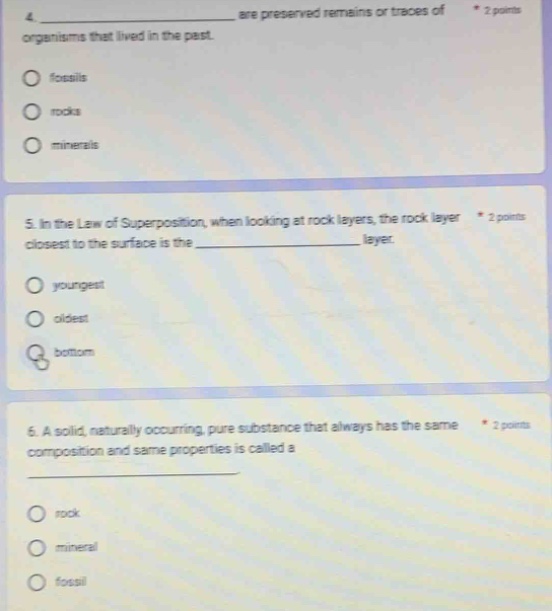
4. ____________ are preserved remains or traces of organisms that lived in the past. * 2 points\no fossils\no rocks\no minerals\n\n5. in the law of superposition, when looking at rock layers, the rock layer closest to the surface is the ____________ layer. * 2 points\no youngest\no oldest\no bottom\n\n6. a solid, naturally occurring, pure substance that always has the same composition and same properties is called a * 2 points\no rock\no mineral\no fossil
Answer
Brief Explanations:
- Fossils are the preserved remains or traces of organisms that lived in the past. Rocks are solid geological materials and minerals are chemical substances within rocks.
- The Law of Superposition states that in undisturbed rock layers, the youngest layer is closest to the surface and the oldest is at the bottom.
- A mineral is a solid, naturally - occurring, pure substance with a consistent composition and properties. Rocks are made up of one or more minerals and fossils are organic remains.
Answer:
- fossils
- youngest
- mineral