president jimmy carter announced that the u.s. would boycott the 1980 olympic games in moscow to oppose…
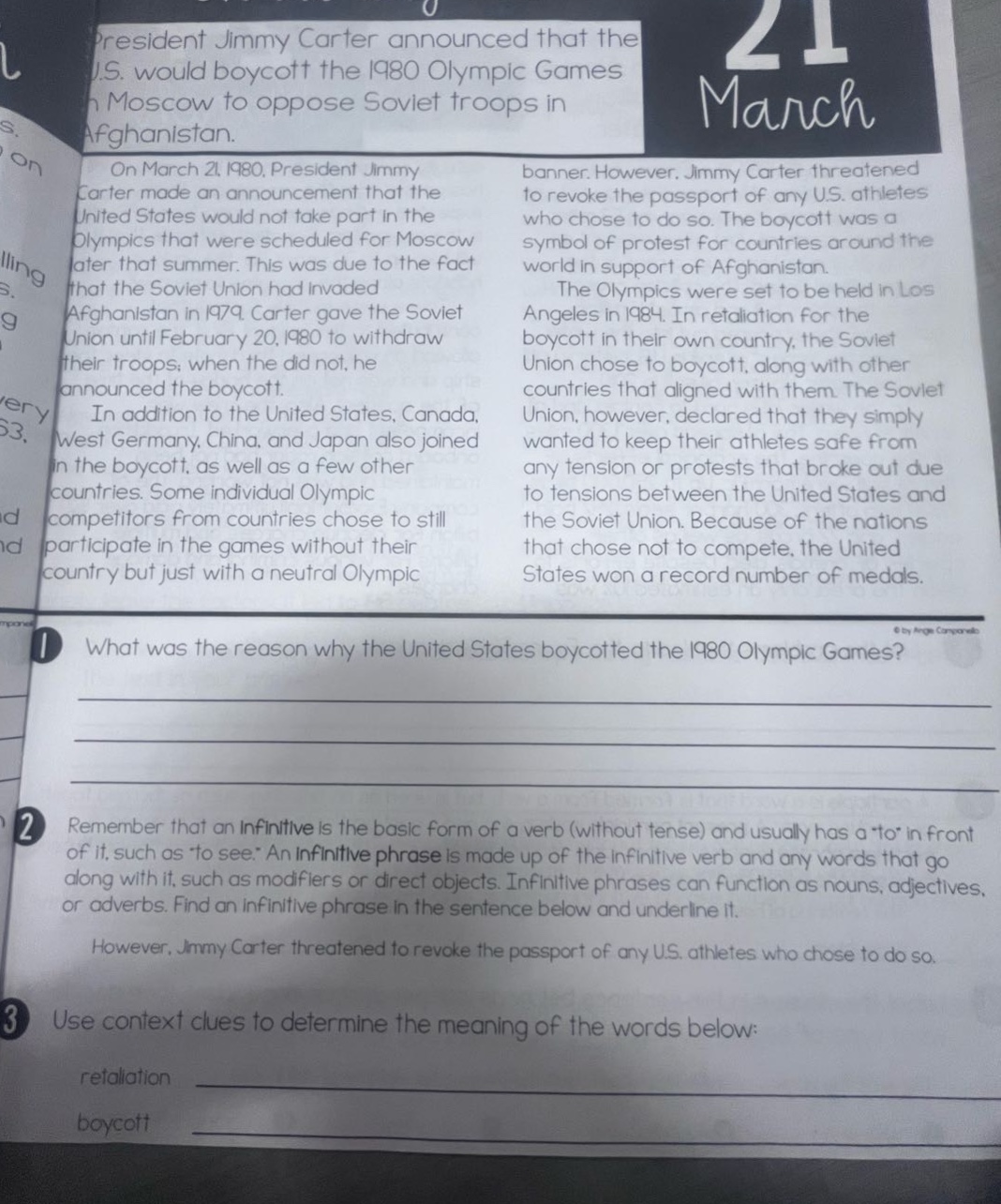
president jimmy carter announced that the u.s. would boycott the 1980 olympic games in moscow to oppose soviet troops in afghanistan. on march 21 1980, president jimmy carter made an announcement that the united states would not take part in the olympics that were scheduled for moscow later that summer. this was due to the fact that the soviet union had invaded afghanistan in 1979. carter gave the soviet union until february 20, 1980 to withdraw their troops; when they did not, he announced the boycott. in addition to the united states, canada, west germany, china, and japan also joined in the boycott, as well as a few other countries. some individual olympic competitors from countries chose to still participate in the games without their country but just with a neutral olympic banner. however, jimmy carter threatened to revoke the passport of any u.s. athletes who chose to do so. the boycott was a symbol of protest for countries around the world in support of afghanistan. the olympics were set to be held in los angeles in 1984. in retaliation for the boycott in their own country, the soviet union chose to boycott, along with other countries that aligned with them. the soviet union, however, declared that they simply wanted to keep their athletes safe from any tension or protests that broke out due to tensions between the united states and the soviet union. because of the nations that chose not to compete, the united states won a record number of medals. what was the reason why the united states boycotted the 1980 olympic games? remember that an infinitive is the basic form of a verb (without tense) and usually has a to in front of it, such as to see. an infinitive phrase is made up of the infinitive verb and any words that go along with it, such as modifiers or direct objects. infinitive phrases can function as nouns, adjectives, or adverbs. find an infinitive phrase in the sentence below and underline it. however, jimmy carter threatened to revoke the passport of any u.s. athletes who chose to do so. use context clues to determine the meaning of the words below: retaliation boycott
Answer
Brief Explanations:
- The text clearly states that the U.S. boycotted the 1980 Olympics in Moscow to oppose Soviet troops in Afghanistan as the Soviet Union had invaded Afghanistan in 1979.
- An infinitive phrase is a group of words that starts with "to" and includes a verb and related words. In the given sentence, "to revoke the passport of any U.S. athletes who chose to do so" is the infinitive phrase as it starts with "to" and has the verb "revoke" along with its related objects.
- For "retaliation", the context shows that the Soviet - Union boycotted the 1984 Olympics in Los Angeles in response to the U.S. - led boycott of the 1980 Olympics, so it means action taken in return for an injury or offense. For "boycott", the text describes countries choosing not to participate in the Olympics as a form of protest, so it means to abstain from using, buying, or dealing with something or someone as a form of protest.
Answer:
- To oppose Soviet troops in Afghanistan as the Soviet Union had invaded Afghanistan in 1979.
- to revoke the passport of any U.S. athletes who chose to do so
- retaliation: action taken in return for an injury or offense; boycott: to abstain from using, buying, or dealing with something or someone as a form of protest.