problem 2: a 30 - year - old man was found shot in the head in his garage. the suspect claims he was being…
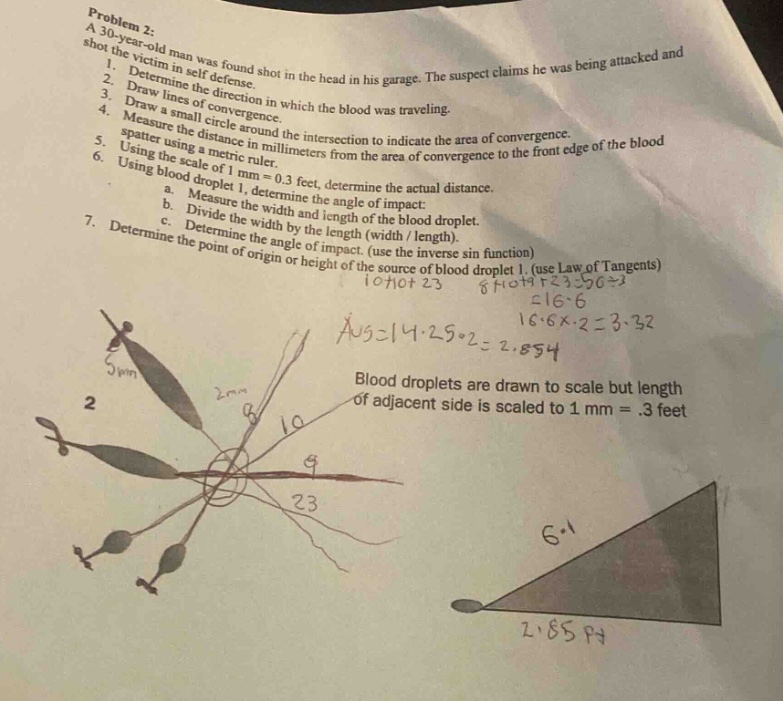
problem 2: a 30 - year - old man was found shot in the head in his garage. the suspect claims he was being attacked and shot the victim in self - defense. 1. determine the direction in which the blood was traveling. 2. draw lines of convergence. 3. draw a small circle around the intersection to indicate the area of convergence. 4. measure the distance in millimeters to the front edge of the blood spatter using a metric ruler. 5. using the scale of 1 mm = 0.3 feet, determine the actual distance. 6. using blood droplet 1, a. determine the angle of impact: b. measure the width and length of the blood droplet. c. divide the width by the length (width / length). 7. determine the point of origin or height of the source of blood droplet 1. (use law of tangents) 10 + 10+23 6 + 10+23 - 96 = 3 16.6 a5 = 14.25 + 2 = 3.32 16.6×2 = 3.32 2.854 blood droplets are drawn to scale but length of adjacent side is scaled to 1 mm =.3 feet
Answer
Explanation:
Step1: Identify given scale
The scale is $1\ mm = 0.3\ feet$.
Step2: Analyze problem - related measurements
We need to use the scale to convert measured distances in mm to actual distances in feet. However, no specific measured distances for conversion are clearly stated in the problem - statement for us to perform a full - fledged calculation. For the angle of impact, if we assume we have the ratio of width to length of the blood droplet (from step 6b), we can use the inverse - sine function. But again, no such values are given clearly.
Step3: General approach for angle of impact
If we had the width $w$ and length $l$ of the blood droplet, the angle of impact $\theta=\sin^{- 1}(\frac{w}{l})$.
Step4: General approach for distance determination
If we measure a distance $d_{mm}$ in millimeters on the diagram, the actual distance $d_{feet}=d_{mm}\times0.3$.
Since the problem lacks clear input values for a full calculation, we can't provide a numerical answer. But the general steps for solving such a problem related to blood - spatter analysis are as above.
Answer:
Insufficient information to provide a numerical answer. General methods for solving: Use scale $1\ mm = 0.3\ feet$ to convert distances and $\theta = \sin^{-1}(\frac{w}{l})$ for angle of impact where $w$ is width and $l$ is length of blood droplet.