the procedure smallest is intended to return the least value in the list numbers. the procedure does not…
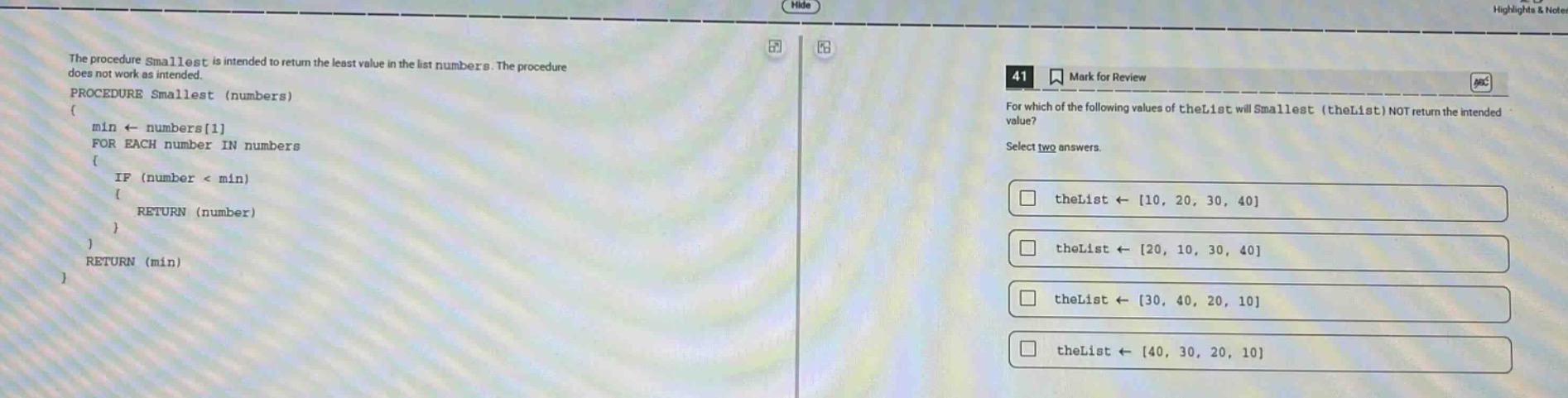
the procedure smallest is intended to return the least value in the list numbers. the procedure does not work as intended. procedure smallest (numbers) { min ← numbers1 for each number in numbers { if (number < min) { return (number) } } return (min) } 41 mark for review for which of the following values of thelist will smallest (thelist) not return the intended value? select two answers. thelist ← 10, 20, 30, 40 thelist ← 20, 10, 30, 40 thelist ← 30, 40, 20, 10 thelist ← 40, 30, 20, 10
Answer
Explanation:
Step1: Analyze the code logic
The code initializes min as the first element of the list (numbers[1]). Then for each number in the list, if the number is less than min, it immediately returns that number instead of updating min and continuing to check the whole list. So it will return the first - encountered number that is smaller than the initial min value, not the overall smallest value in the list.
Step2: Test each option
For theList ← [10, 20, 30, 40]: The first element 10 is set as min and no smaller number is encountered before the end of the loop, so it will return 10 which is the correct smallest value.
For theList ← [20, 10, 30, 40]: The first element 20 is set as min. When it encounters 10, it will return 10 immediately without checking the rest of the list. But this is still the correct smallest value.
For theList ← [30, 40, 20, 10]: The first element 30 is set as min. When it encounters 20, it will return 20 instead of continuing to find the actual smallest value 10.
For theList ← [40, 30, 20, 10]: The first element 40 is set as min. When it encounters 30, it will return 30 instead of continuing to find the actual smallest value 10.
Answer:
theList ← [30, 40, 20, 10], theList ← [40, 30, 20, 10]