the procedure smallest is intended to return the least value in the list numbers. the procedure does not…
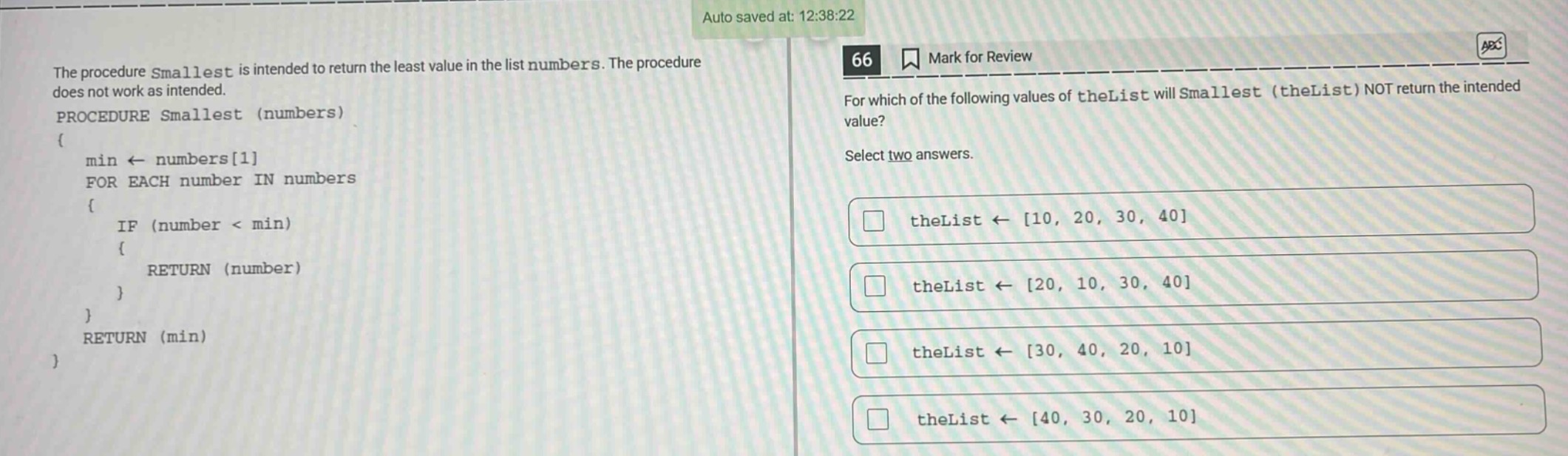
the procedure smallest is intended to return the least value in the list numbers. the procedure does not work as intended. procedure smallest (numbers) { min ← numbers1 for each number in numbers { if (number < min) { return (number) } } return (min) } 66 mark for review for which of the following values of thelist will smallest (thelist) not return the intended value? select two answers. thelist ← 10, 20, 30, 40 thelist ← 20, 10, 30, 40 thelist ← 30, 40, 20, 10 thelist ← 40, 30, 20, 10
Answer
Answer:
B. theList ← [20, 10, 30, 40], C. theList ← [30, 40, 20, 10]
Explanation:
Step1: Analyze the procedure logic
The procedure sets min to the first element and returns an element as soon as it finds a smaller one instead of checking the whole list.
Step2: Check option A
For [10, 20, 30, 40], it will correctly return 10 as it sets min to 10 first and no smaller element is found before the end.
Step3: Check option B
For [20, 10, 30, 40], when it reaches 10 (second element), it will return 10 immediately without checking the rest, while the correct minimum should be found after checking all.
Step4: Check option C
For [30, 40, 20, 10], when it reaches 20 (third element), it will return 20 immediately without checking 10, which is incorrect.
Step5: Check option D
For [40, 30, 20, 10], it will return 10 correctly as it will keep updating min until the end.