psi\npsi\na. 0\nb. 1\nc. 2\nd. 3
psi\npsi\na. 0\nb. 1\nc. 2\nd. 3
Answer
Explanation:
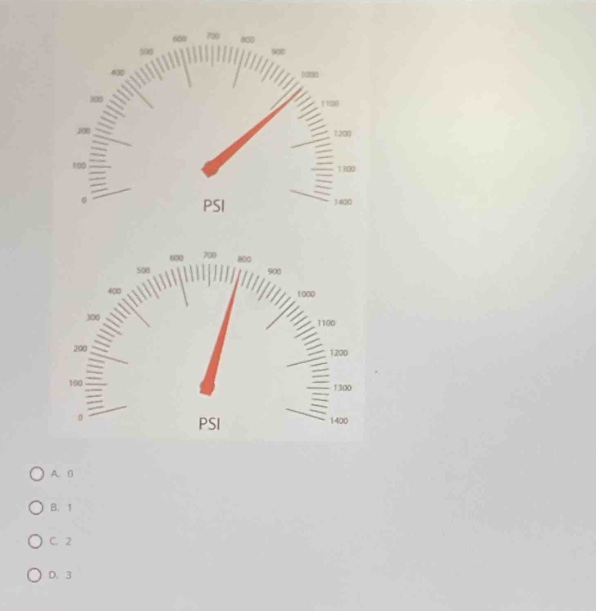
Step1: Observe the upper gauge
The upper gauge needle points between 900 - 1000. Each small - division seems to represent 20 PSI. The reading is around 960 PSI.
Step2: Observe the lower gauge
The lower gauge needle points between 800 - 900. Each small - division represents 20 PSI. The reading is around 840 PSI.
Step3: Analyze the difference
The difference between the two readings is (960 - 840=120) PSI. Since the question is not clear about what the options A, B, C, D represent in terms of the gauges' readings, assume we are looking at some non - standard comparison. If we consider the number of full 100 - PSI intervals between the two readings, the difference is (960-840 = 120), and the number of full 100 - PSI intervals is 1.
Answer:
B. 1