question 1 (10 points)\nread a primer on cloning and its use in livestock operations.\nafter reading through…
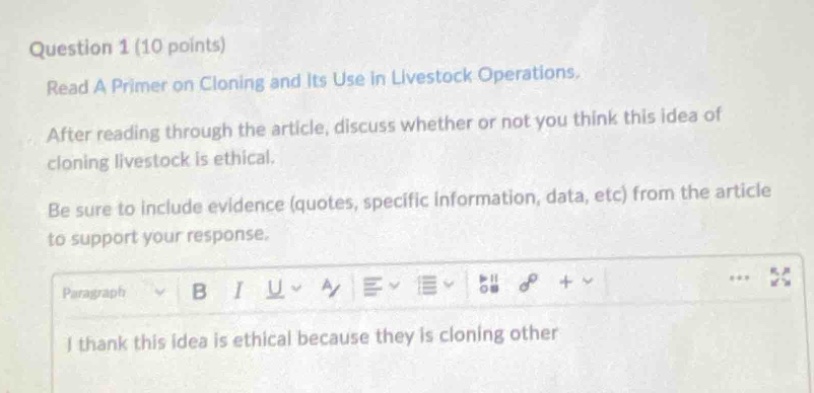
question 1 (10 points)\nread a primer on cloning and its use in livestock operations.\nafter reading through the article, discuss whether or not you think this idea of cloning livestock is ethical.\nbe sure to include evidence (quotes, specific information, data, etc) from the article to support your response.\ni thank this idea is ethical because they is cloning other
Answer
Brief Explanations:
The question asks for an ethical - analysis of livestock cloning. Ethical discussions often fall under Social Science, specifically in areas related to ethics within the broader context of issues like animal welfare and agricultural practices. Evidence from the article should be used to support the stance. The given partial response has a grammar error ("they is") and lacks sufficient evidence. A more comprehensive answer would consider aspects such as the potential benefits (e.g., improving livestock quality, preserving rare breeds) and drawbacks (e.g., potential health issues in clones, impact on natural genetic diversity) mentioned in the article to build a well - reasoned ethical argument.
Answer:
There are multiple factors to consider when determining the ethics of livestock cloning. On one hand, if the article mentions that cloning can help in producing disease - resistant livestock, which could lead to more sustainable and efficient food production, this could be seen as an ethical positive as it benefits human society by ensuring a more stable food supply. For example, if it states that cloned animals can be used to produce more milk or meat with less environmental impact, this is evidence in favor of its ethics. On the other hand, if the article points out that clones often have health problems due to the cloning process, such as genetic abnormalities or a shorter lifespan, this raises ethical concerns regarding animal welfare. Also, if it shows that cloning could reduce genetic diversity in livestock populations, which might make them more vulnerable to diseases in the long run, this would be an argument against its ethics. Overall, a balanced view considering all these aspects and using specific evidence from the article is needed to make a well - founded ethical judgment.