question 23 (0.5 points) retake question\nwhy do buildings on permafrost have potential structural…
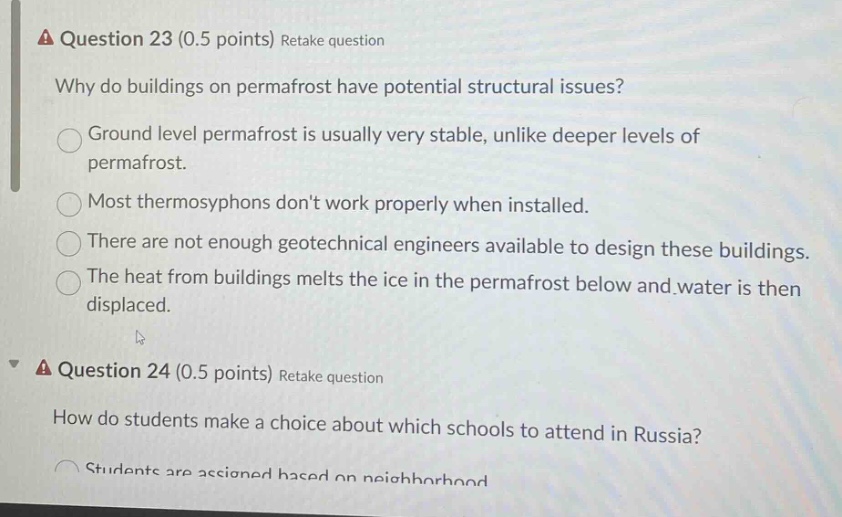
question 23 (0.5 points) retake question\nwhy do buildings on permafrost have potential structural issues?\nground level permafrost is usually very stable, unlike deeper levels of permafrost.\nmost thermosyphons dont work properly when installed.\nthere are not enough geotechnical engineers available to design these buildings.\nthe heat from buildings melts the ice in the permafrost below and water is then displaced.\nquestion 24 (0.5 points) retake question\nhow do students make a choice about which schools to attend in russia?\nstudents are assigned based on neighborhood
Answer
Brief Explanations:
For Question 23, permafrost contains ice. Heat from buildings can melt this ice, causing ground instability and structural issues. For Question 24, the provided answer - students are assigned based on neighborhood - is a common factor in school - choice in many regions including potentially Russia.
Answer:
Question 23: The heat from buildings melts the ice in the permafrost below and water is then displaced. Question 24: Students are assigned based on neighborhood.