question 31\nfossils of the fern glossopteris have been found in south america, africa, india, antarctica…
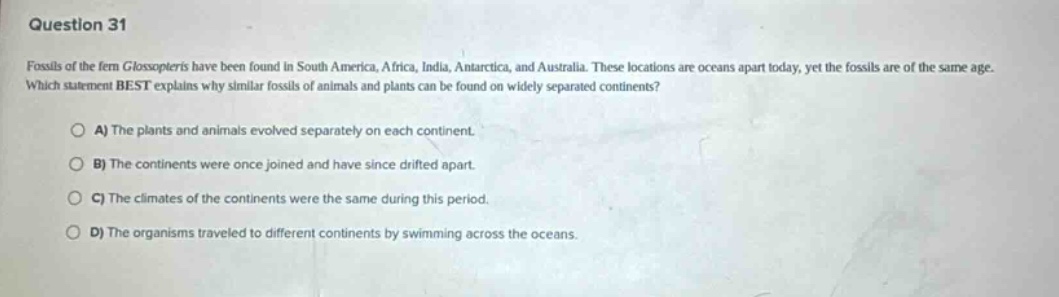
question 31\nfossils of the fern glossopteris have been found in south america, africa, india, antarctica, and australia. these locations are oceans apart today, yet the fossils are of the same age. which statement best explains why similar fossils of animals and plants can be found on widely separated continents?\na) the plants and animals evolved separately on each continent.\nb) the continents were once joined and have since drifted apart.\nc) the climates of the continents were the same during this period.\nd) the organisms traveled to different continents by swimming across the oceans.
Answer
Brief Explanations:
The theory of continental drift states that the continents were once joined as a single land - mass (Pangaea) and have since drifted apart. This explains why similar fossils can be found on widely separated continents as the organisms were originally together on the single land - mass. Option A is incorrect as similar fossils suggest a common origin rather than separate evolution. Option C, similar climates do not necessarily lead to identical species and fossils. Option D, it is highly unlikely for many of these organisms to swim across vast oceans.
Answer:
B) The continents were once joined and have since drifted apart.