question 67 (1 point)\nwhich of the following would experts not recommend to be amalgamated?\no a hydrogen…
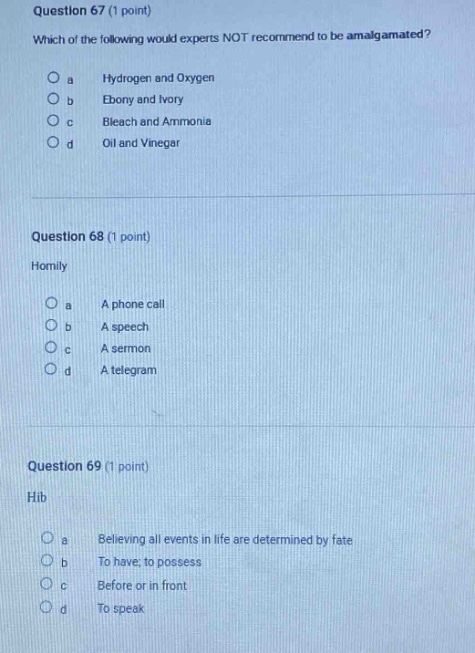
question 67 (1 point)\nwhich of the following would experts not recommend to be amalgamated?\no a hydrogen and oxygen\no b ebony and ivory\no c bleach and ammonia\no d oil and vinegar\n\nquestion 68 (1 point)\nhomily\no a a phone call\no b a speech\no c a sermon\no d a telegram\n\nquestion 69 (1 point)\nhib\no a believing all events in life are determined by fate\no b to have; to possess\no c before or in front\no d to speak
Answer
Brief Explanations:
- Question 67: Bleach and ammonia react to form toxic gases, so they should not be amalgamated. Hydrogen and oxygen can form water under certain conditions, ebony and ivory are materials that can be combined in some crafts, and oil and vinegar can form a mixture (like salad - dressing).
- Question 68: A homily is a sermon, usually given in a religious context to convey religious teachings or moral lessons. A phone call, speech, and telegram are different forms of communication not related to the definition of homily.
- Question 69: "Hib" is not a common English root or word with a well - known meaning among the options. However, "fate" is related to the concept of "hib" in some archaic or specialized usages where it can imply a kind of predestination or determination.
Answer:
- Question 67: C. Bleach and Ammonia
- Question 68: C. A sermon
- Question 69: A. Believing all events in life are determined by fate