question 4 (gears and mechanical advantage) 10 marks\n4.1 study the two gear - systems below and answer…
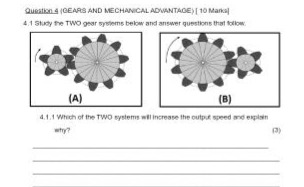
question 4 (gears and mechanical advantage) 10 marks\n4.1 study the two gear - systems below and answer questions that follow:\n(a)\n(b)\n4.1.1 which of the two systems will increase the output speed and explain why?\n(3)
Answer
Explanation:
Step1: Recall gear - speed relationship
In a gear system, the speed ratio is inversely proportional to the gear - ratio. A smaller driving gear and a larger driven gear result in a decrease in speed but an increase in torque, and vice - versa.
Step2: Analyze System A
In System A, the smaller gear is driving the larger gear. The gear - ratio (r_A=\frac{N_{large}}{N_{small}}\gt1), where (N) is the number of teeth. According to the speed - gear ratio relationship (n_{output}=\frac{n_{input}}{r_A}), so the output speed will be lower than the input speed.
Step3: Analyze System B
In System B, the larger gear is driving the smaller gear. The gear - ratio (r_B = \frac{N_{small}}{N_{large}}\lt1). Using the speed - gear ratio relationship (n_{output}=\frac{n_{input}}{r_B}), since (r_B\lt1), the output speed will be higher than the input speed.
Answer:
System B will increase the output speed. This is because in System B, the larger gear is driving the smaller gear. The gear - ratio is less than 1, and according to the speed - gear ratio relationship, the output speed is higher than the input speed.