question 6 (2 points)\nthe development of sperm cells (2 points)\n a occurs during adulthood\n b begins…
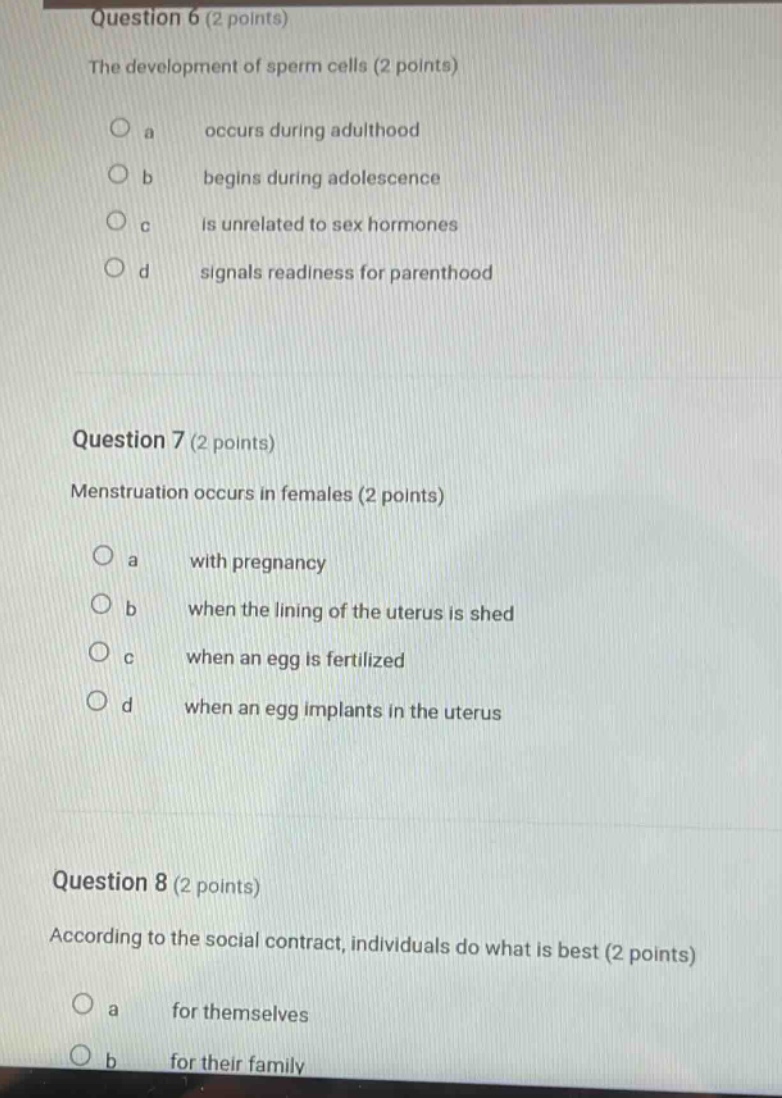
question 6 (2 points)\nthe development of sperm cells (2 points)\n a occurs during adulthood\n b begins during adolescence\n c is unrelated to sex hormones\n d signals readiness for parenthood\n\nquestion 7 (2 points)\nmenstruation occurs in females (2 points)\n a with pregnancy\n b when the lining of the uterus is shed\n c when an egg is fertilized\n d when an egg implants in the uterus\n\nquestion 8 (2 points)\naccording to the social contract, individuals do what is best (2 points)\n a for themselves\n b for their family
Answer
Brief Explanations:
- For Question 6: Sperm - cell development in males begins during adolescence due to hormonal changes.
- For Question 7: Menstruation occurs when the uterine lining is shed as there is no pregnancy.
- For Question 8: In the social - contract theory, individuals act in the best interest of society as a whole, but among the given options, doing what is best for themselves is not correct as the focus is on the collective. The closest relevant idea among the options is not fully accurate but the social - contract implies a balance and often acting for the common good rather than just family.
Answer:
Question 6: B. begins during adolescence Question 7: B. when the lining of the uterus is shed Question 8: None of the above options are completely accurate based on social - contract theory, but if we have to choose, the social - contract is more about the collective than just family or self, so the question has no ideal answer among the given ones.