question 2\n1 pts\nhere is an argument structure called modus ponens. its a famous form. thats why it has a…
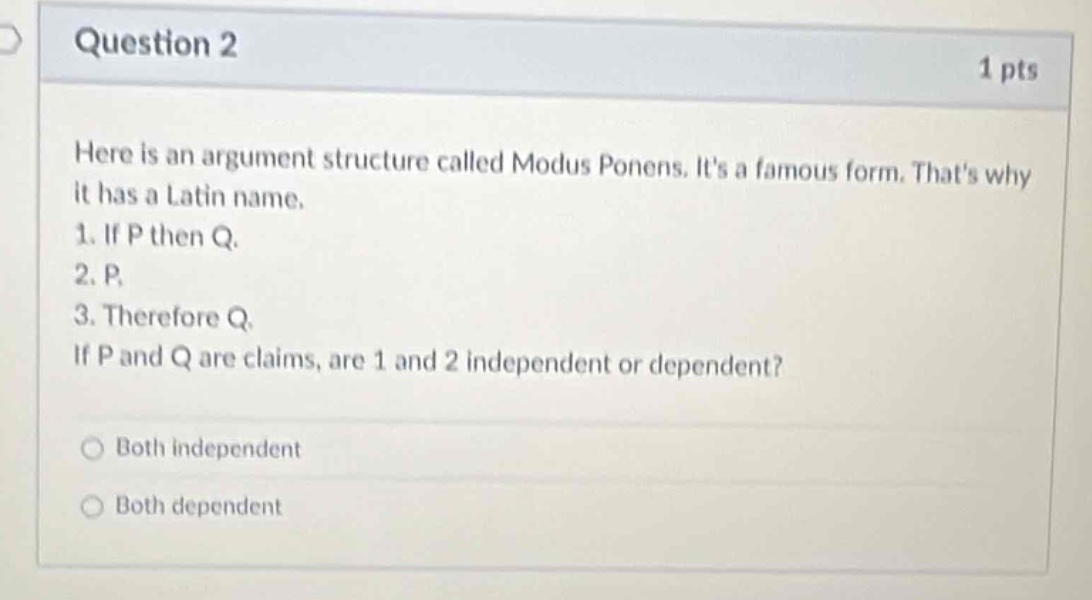
question 2\n1 pts\nhere is an argument structure called modus ponens. its a famous form. thats why it has a latin name.\n1. if p then q.\n2. p.\n3. therefore q.\nif p and q are claims, are 1 and 2 independent or dependent?\nboth independent\nboth dependent
Answer
Brief Explanations:
In Modus Ponens, the first premise "If P then Q" sets a conditional relationship. The second premise "P" is needed to trigger the conclusion "Q" based on the first - premise's condition. So, they are dependent on each other to reach the conclusion.
Answer:
Both dependent