9. if r3 opens, what happens to total resistance? a increases b decreases c stays the same 120 v r1 600 ω r2…
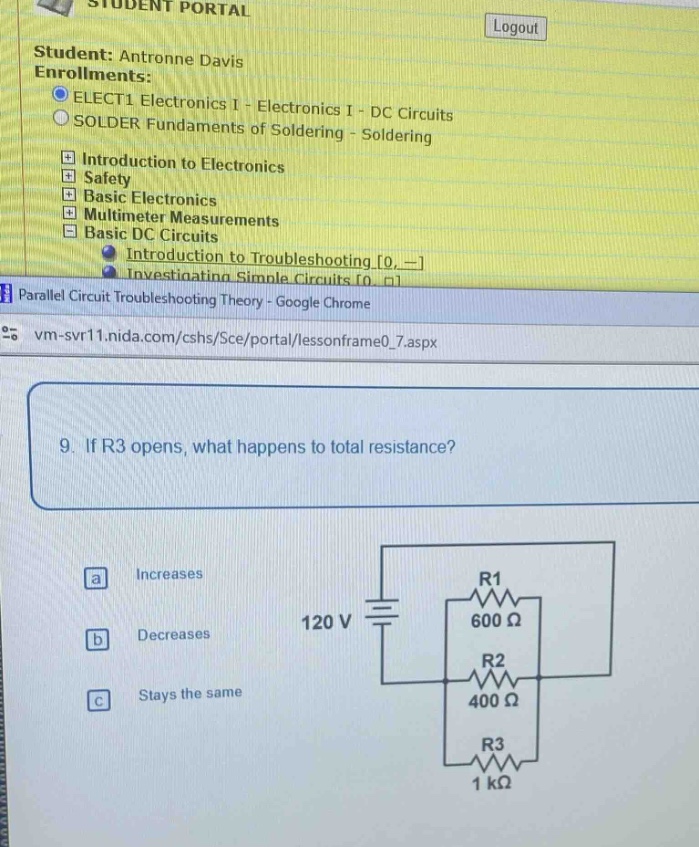
9. if r3 opens, what happens to total resistance? a increases b decreases c stays the same 120 v r1 600 ω r2 400 ω r3 1 kω
Answer
Explanation:
Step1: Recall parallel - resistance formula
For resistors in parallel, the formula for total resistance $R_T$ is $\frac{1}{R_T}=\frac{1}{R_1}+\frac{1}{R_2}+\frac{1}{R_3}$. Initially, with $R_1 = 600\Omega$, $R_2=400\Omega$ and $R_3 = 1000\Omega$, we have $\frac{1}{R_{T1}}=\frac{1}{600}+\frac{1}{400}+\frac{1}{1000}$.
Step2: Calculate initial total resistance
First, find a common denominator, which is 6000. Then $\frac{1}{R_{T1}}=\frac{10 + 15+6}{6000}=\frac{31}{6000}$, so $R_{T1}=\frac{6000}{31}\approx193.55\Omega$.
Step3: Analyze when R3 opens
When $R_3$ opens, it is equivalent to removing $R_3$ from the parallel - circuit. Now the formula for total resistance becomes $\frac{1}{R_{T2}}=\frac{1}{R_1}+\frac{1}{R_2}$. With $R_1 = 600\Omega$ and $R_2 = 400\Omega$, the common denominator is 1200. So $\frac{1}{R_{T2}}=\frac{2 + 3}{1200}=\frac{5}{1200}$, and $R_{T2}=240\Omega$.
Step4: Compare total resistances
Since $R_{T2}(240\Omega)>R_{T1}(193.55\Omega)$, the total resistance increases.
Answer:
A. Increases