radioactive decay of ⁴⁰k atoms in an igneous rock has resulted in a ratio of 25 percent ⁴⁰k atoms to 75…
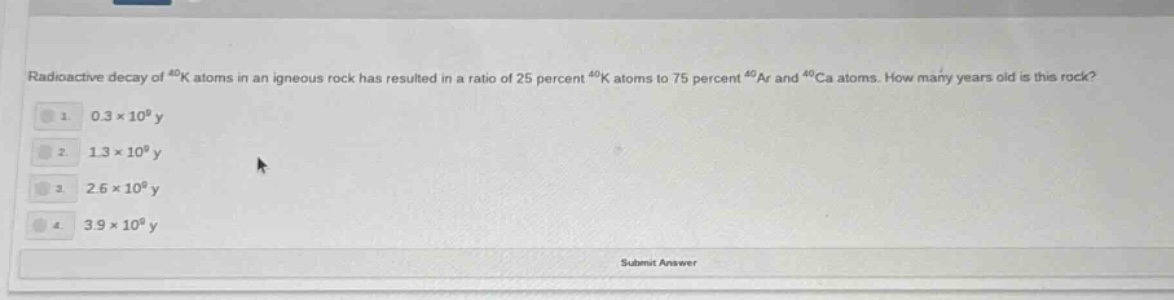
radioactive decay of ⁴⁰k atoms in an igneous rock has resulted in a ratio of 25 percent ⁴⁰k atoms to 75 percent ⁴⁰ar and ⁴⁰ca atoms. how many years old is this rock? 1. 0.3×10⁹ y 2. 1.3×10⁹ y 3. 2.6×10⁹ y 4. 3.9×10⁹ y
Answer
Explanation:
Step1: Understand radioactive - decay concept
The half - life of $^{40}K$ is about $1.25\times10^{9}$ years. Initially, assume there was 100% $^{40}K$. Now, 25% $^{40}K$ remains.
Step2: Determine number of half - lives
If the fraction of the parent isotope ($N/N_0$) remaining is $N/N_0 = 0.25$, and the formula for radioactive decay is $N = N_0(\frac{1}{2})^n$, where $N$ is the amount of parent isotope at time $t$, $N_0$ is the initial amount of parent isotope, and $n$ is the number of half - lives. Setting $N/N_0=0.25 = (\frac{1}{2})^n$, we find $n = 2$ (since $(\frac{1}{2})^2=0.25$).
Step3: Calculate age of the rock
The age of the rock $t$ is given by $t = n\times t_{1/2}$, where $t_{1/2}$ is the half - life of $^{40}K$. Given $t_{1/2}=1.25\times 10^{9}$ years and $n = 2$, then $t=2\times1.25\times 10^{9}=2.5\times 10^{9}$ years, which is closest to $2.6\times 10^{9}$ years.
Answer:
- $2.6\times 10^{9}y$