how is radioactive decay used to date sedimentary rocks?\nthe amounts of potassium and argon in sedimentary…
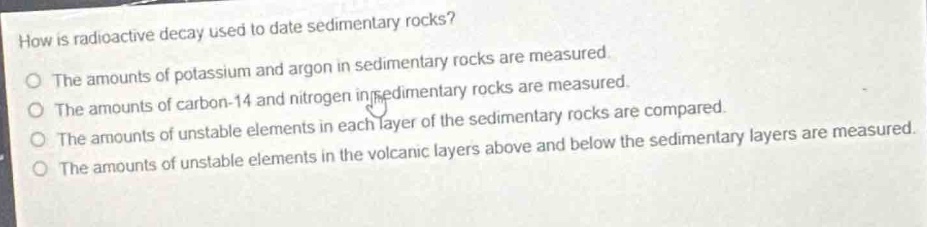
how is radioactive decay used to date sedimentary rocks?\nthe amounts of potassium and argon in sedimentary rocks are measured.\nthe amounts of carbon - 14 and nitrogen in sedimentary rocks are measured.\nthe amounts of unstable elements in each layer of the sedimentary rocks are compared.\nthe amounts of unstable elements in the volcanic layers above and below the sedimentary layers are measured.\nthe amounts of unstable elements in the volcanic layers above and below the sedimentary layers are measured.
Answer
Brief Explanations:
Sedimentary rocks are composed of particles from pre - existing rocks. They cannot be directly dated by radioactive decay as the original minerals are broken down. Instead, the volcanic layers above and below sedimentary layers can be dated using radioactive decay of unstable elements in them.
Answer:
The amounts of unstable elements in the volcanic layers above and below the sedimentary layers are measured.