read the following section. once you have completed the reading answer the questions below\nholt mcdougal…
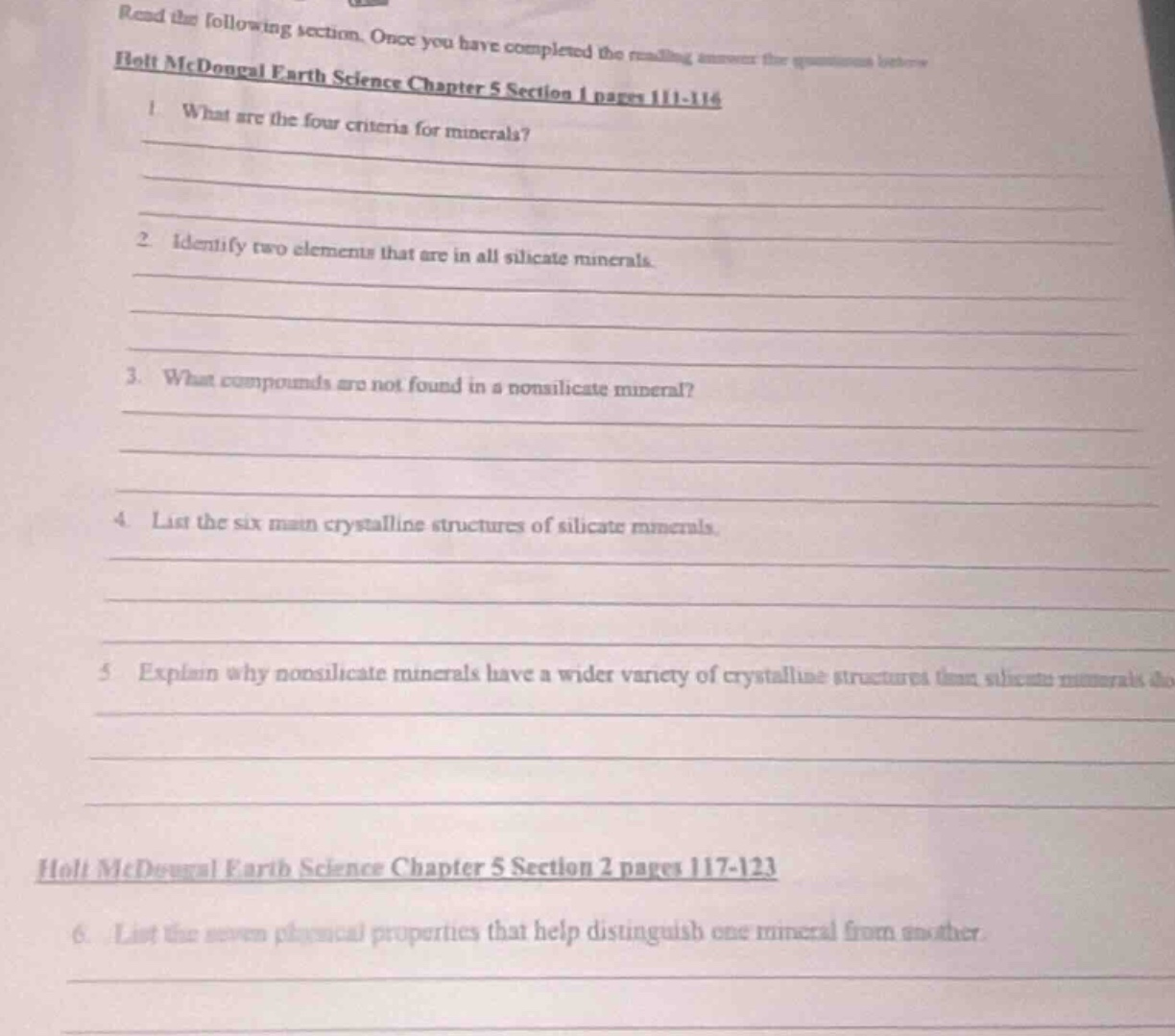
read the following section. once you have completed the reading answer the questions below\nholt mcdougal earth science chapter 5 section 1 pages 111 - 116\n1. what are the four criteria for minerals?\n2. identify two elements that are in all silicate minerals.\n3. what compounds are not found in a nonsilicate mineral?\n4. list the six main crystalline structures of silicate minerals.\n5. explain why nonsilicate minerals have a wider variety of crystalline structures than silicate minerals do.\nholt mcdougal earth science chapter 5 section 2 pages 117 - 123\n6. list the seven physical properties that help distinguish one mineral from another
Answer
Brief Explanations:
- Minerals are defined by being naturally - occurring, inorganic, having a definite chemical composition, and a characteristic crystalline structure.
- Silicon and oxygen are the two elements in all silicate minerals.
- Silicate compounds are not found in non - silicate minerals.
- The six main crystalline structures of silicate minerals are isolated tetrahedra, single chains, double chains, sheets, frameworks, and ring structures.
- Nonsilicate minerals have a wider variety of crystalline structures because they are not restricted by the silicate tetrahedron structure like silicate minerals are.
- The seven physical properties that help distinguish one mineral from another are color, streak, luster, hardness, cleavage, fracture, and density.
Answer:
- Naturally - occurring, inorganic, definite chemical composition, characteristic crystalline structure.
- Silicon, oxygen.
- Silicate compounds.
- Isolated tetrahedra, single chains, double chains, sheets, frameworks, ring structures.
- Not restricted by silicate tetrahedron structure.
- Color, streak, luster, hardness, cleavage, fracture, density.