read the passage and answer the following questions. dating rock layers scientists can determine the age of…
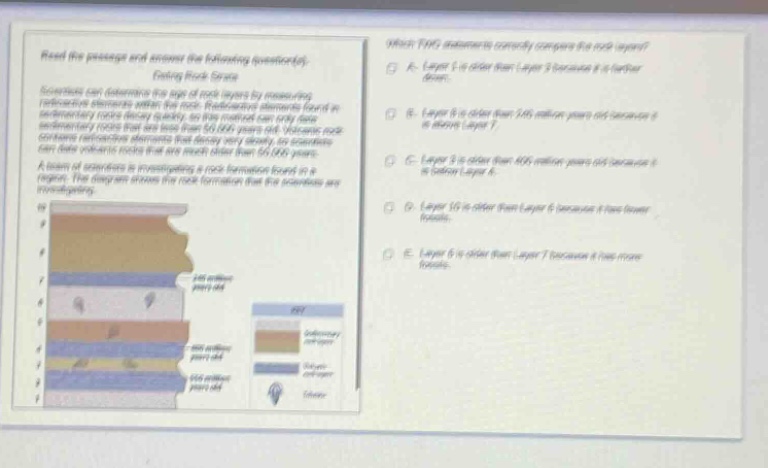
read the passage and answer the following questions. dating rock layers scientists can determine the age of rock layers by measuring radioactive elements within the rock. radioactive elements found in sedimentary rocks decay slowly. the amount of decay can be used to date rocks that are less than 50,000 years old. volcanic rock can date radioactive elements that decay more than 50,000 years old. scientists can also use index fossils to help date rock layers. a team of scientists is investigating a rock formation found in a canyon. the diagram shows the rock formation that the scientists are investigating. which two statements correctly compare the rock layers? a. layer 5 is older than layer 3 because it is farther down. b. layer 6 is older than 466 million years old because it is below layer 7. c. layer 3 is older than 466 million years old because it is below layer 6. d. layer 10 is older than layer 6 because it has fewer fossils. e. layer 6 is older than layer 7 because it has more fossils.
Answer
Brief Explanations:
According to the principle of superposition in geology, in an undisturbed sequence of sedimentary rock layers, the oldest layer is at the bottom and the layers get younger as you move up. Also, fossils can sometimes help in relative - age dating.
- Option A: Layer 1 is older than Layer 3 because it is lower down, which is correct based on the principle of superposition.
- Option B: If Layer 6 is below Layer 7, it is older. But the statement about being 466 million years old is not supported by the given information about relative - age dating.
- Option C: There is no information to support that Layer 5 is older than 466 million years old just from the relative position.
- Option D: Layer 15 is above Layer 6, so it is younger, not older.
- Option E: Just having more fossils does not necessarily mean a layer is older.
Answer:
A. Layer 1 is older than Layer 3 because it is lower down.