read the text. university of utah engineers have developed \smart glasses\ designed to act like the eyes…
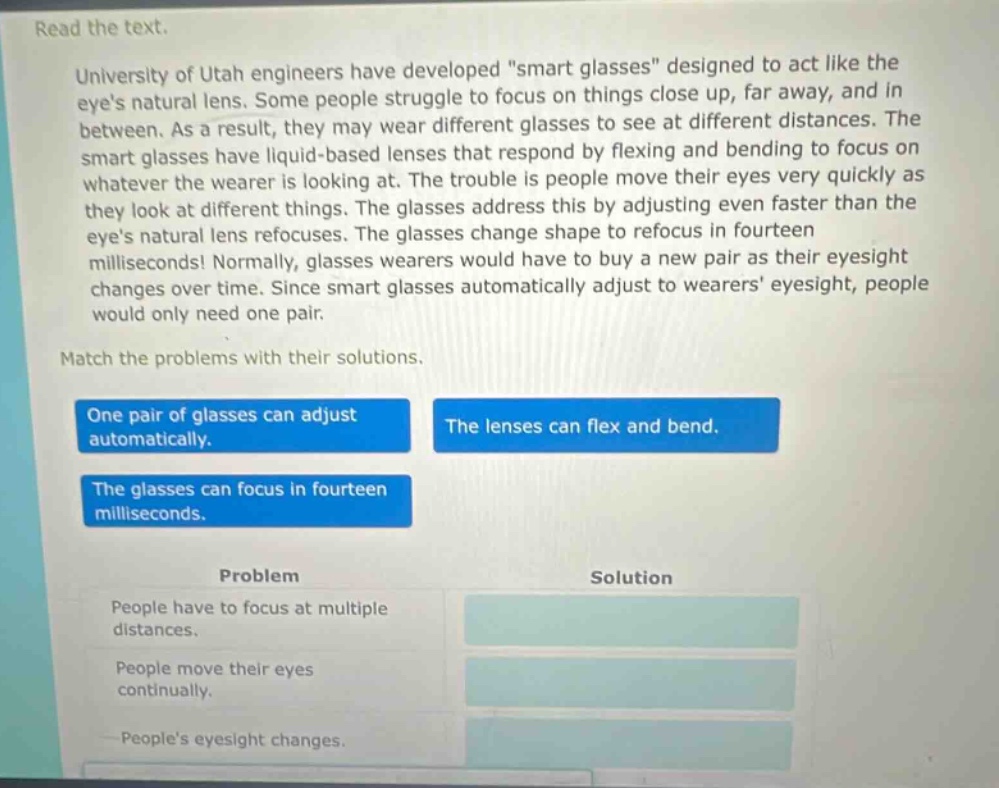
read the text. university of utah engineers have developed \smart glasses\ designed to act like the eyes natural lens. some people struggle to focus on things close up, far away, and in between. as a result, they may wear different glasses to see at different distances. the smart glasses have liquid - based lenses that respond by flexing and bending to focus on whatever the wearer is looking at. the trouble is people move their eyes very quickly as they look at different things. the glasses address this by adjusting even faster than the eyes natural lens refocuses. the glasses change shape to refocus in fourteen milliseconds! normally, glasses wearers would have to buy a new pair as their eyesight changes over time. since smart glasses automatically adjust to wearers eyesight, people would only need one pair. match the problems with their solutions. one pair of glasses can adjust automatically. the lenses can flex and bend. the glasses can focus in fourteen milliseconds. problem solution people have to focus at multiple distances. people move their eyes continually. peoples eyesight changes.
Answer
Brief Explanations:
- For the problem of focusing at multiple distances, the solution is that the lenses can flex and bend to adjust focus on different - distance objects.
- For the problem of eyes moving continually, the solution is that the glasses can focus in fourteen milliseconds, adjusting faster than the eye's natural lens.
- For the problem of eyesight changing, the solution is that one pair of glasses can adjust automatically.
Answer:
People have to focus at multiple distances. - The lenses can flex and bend. People move their eyes continually. - The glasses can focus in fourteen milliseconds. People's eyesight changes. - One pair of glasses can adjust automatically.