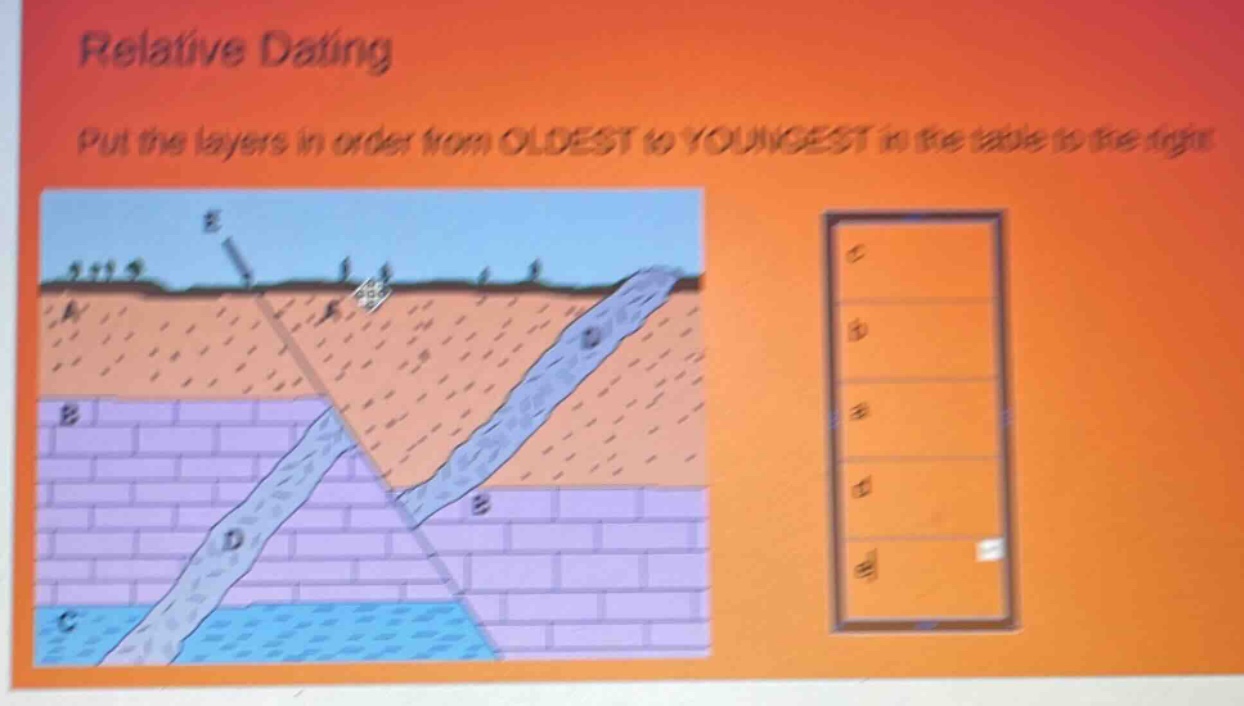
relative dating\nput the layers in order from oldest to youngest in the table to the right
relative dating\nput the layers in order from oldest to youngest in the table to the right
Answer
Explanation:
Step1: Apply law of superposition
In undisturbed sedimentary - rock layers, the oldest layer is at the bottom. So, layer C is the oldest as it is at the very bottom.
Step2: Consider cross - cutting relationships
Layer D cuts through layers C and B, so D is younger than C and B. But since B is above C, B is younger than C and D is younger than B.
Step3: Analyze intrusion and deposition
Layer A is deposited on top of B and D, so A is younger than B and D. Fault E cuts through all the layers except F, so E is younger than A, B, C, D and older than F. F is the youngest as it is on the surface.
Answer:
C, B, D, A, E, F