relative dating\nuse to diagram a for questions 1 - 5\n1. determine the relative ages of layers a - g…
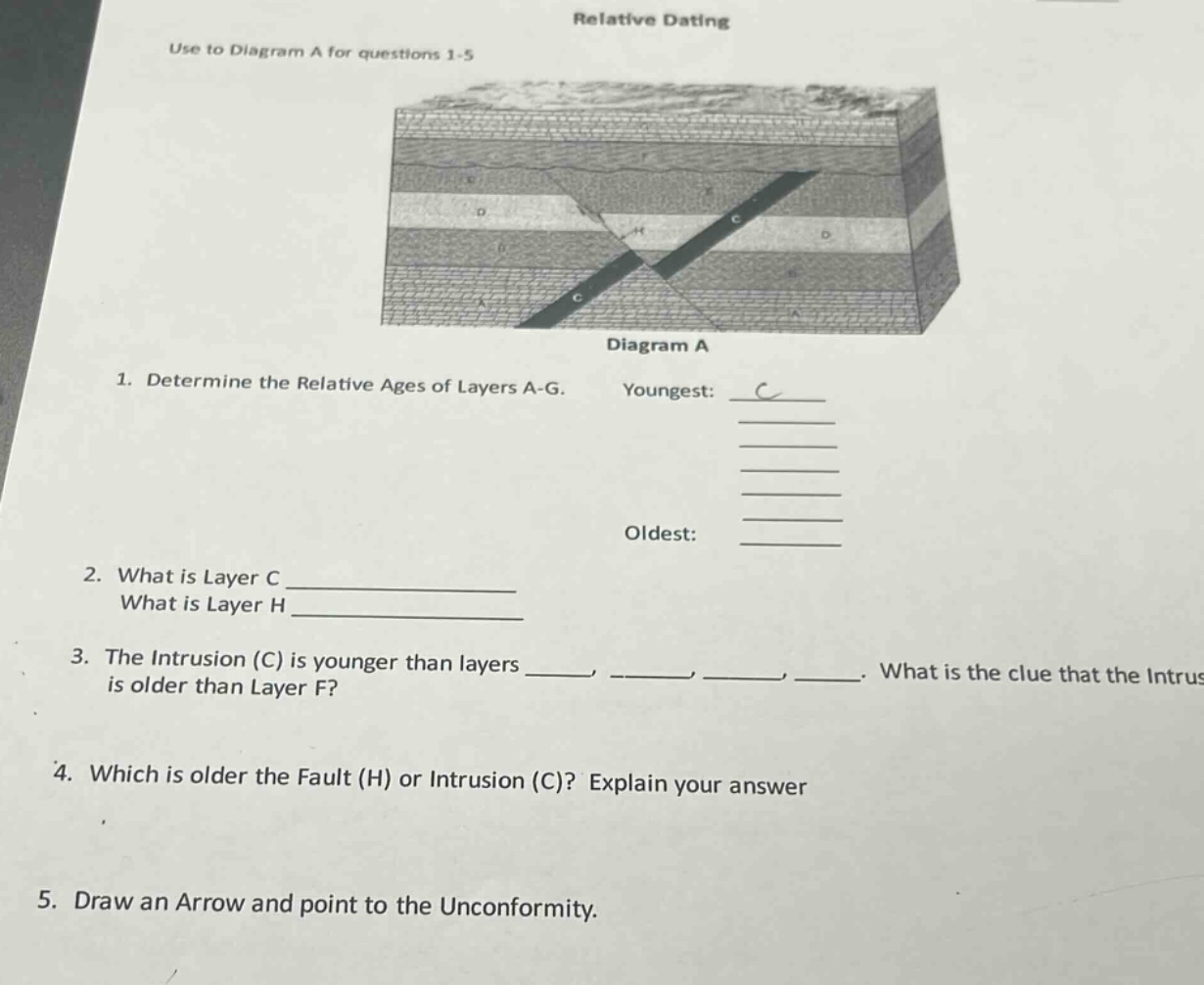
relative dating\nuse to diagram a for questions 1 - 5\n1. determine the relative ages of layers a - g. youngest: \noldest: \n2. what is layer c \nwhat is layer h \n3. the intrusion (c) is younger than layers _, _, _, _. what is the clue that the intrusion is older than layer f?\n4. which is older the fault (h) or intrusion (c)? explain your answer\n5. draw an arrow and point to the unconformity.
Answer
Answer:
- Youngest: C; Oldest: A
- Layer C is an intrusion. Layer H is a fault.
- The Intrusion (C) is younger than layers A, B, D, E. The clue that the Intrusion is older than Layer F is that Layer F lies on top of the Intrusion.
- The Fault (H) is older. Explanation: The intrusion (C) cuts through the fault (H), so the fault must have formed first before the intrusion occurred.
- (This cannot be directly provided in text - you would need to look at the diagram and identify the unconformity which is a surface where there is a break in the geologic record, usually a wavy - eroded surface between rock layers and then draw an arrow pointing to it on the actual diagram).
Explanation:
Step1: Apply principle of superposition
In undisturbed rock layers, the oldest is at the bottom and youngest at the top. So A is the oldest among A - G and since C intrudes other layers, it is the youngest.
Step2: Identify geological features
Based on their shapes and how they interact with other layers, C is an intrusion and H is a fault.
Step3: Analyze intrusion relationships
An intrusion is younger than the layers it cuts through. So C is younger than A, B, D, E. And since F lies above C, C is older than F.
Step4: Determine relative age of fault and intrusion
The principle of cross - cutting relationships states that the feature that cuts through another is younger. Since C cuts through H, H is older.
Step5: Understand unconformity concept
An unconformity is a gap in the geologic record. One would need to visually identify the eroded surface in the diagram and draw an arrow to it.