review questions answer the following questions. 1. what did you notice that was similar about the…
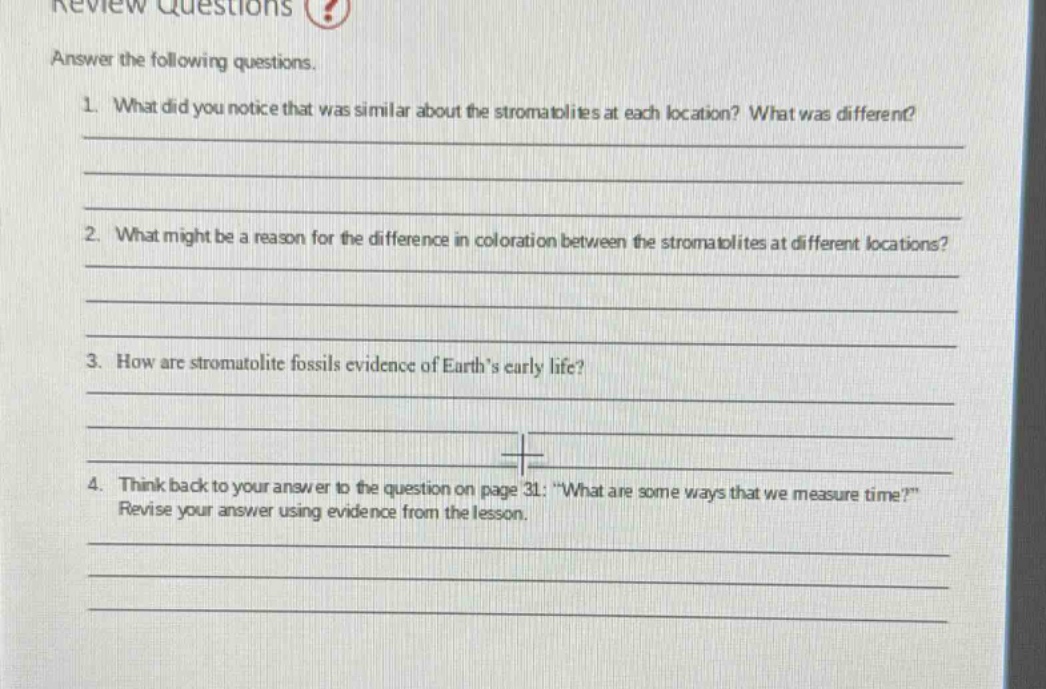
review questions answer the following questions. 1. what did you notice that was similar about the stromatolites at each location? what was different? 2. what might be a reason for the difference in coloration between the stromatolites at different locations? 3. how are stromatolite fossils evidence of earths early life? 4. think back to your answer to the question on page 31: “what are some ways that we measure time?” revise your answer using evidence from the lesson.
Answer
Brief Explanations:
- Similarities could include general layered structure; differences might be in size, shape or degree of weather - ing.
- Differences in coloration could be due to variations in mineral content, presence of different microorganisms, or exposure to different environmental conditions like light and water chemistry.
- Stromatolite fossils are evidence of early life as they are formed by the activity of ancient photosynthetic microorganisms (cyanobacteria). Their layered structure is a result of the accumulation of these organisms over time.
- Without knowing the content of the lesson, common ways to measure time include using clocks (mechanical or atomic), calendars (solar or lunar - based), and geological time markers (such as rock layers and fossils).
Answer:
- Similarities: General layered structure. Differences: Size, shape, weather - ing degree.
- Reason: Mineral content, microorganisms, environmental conditions.
- Evidence: Formed by ancient photosynthetic microorganisms, layered structure from organism accumulation.
- Ways: Clocks, calendars, geological time markers.