a rivers moving water can weather and erode rock and eventually produce a river valley. the diagram below…
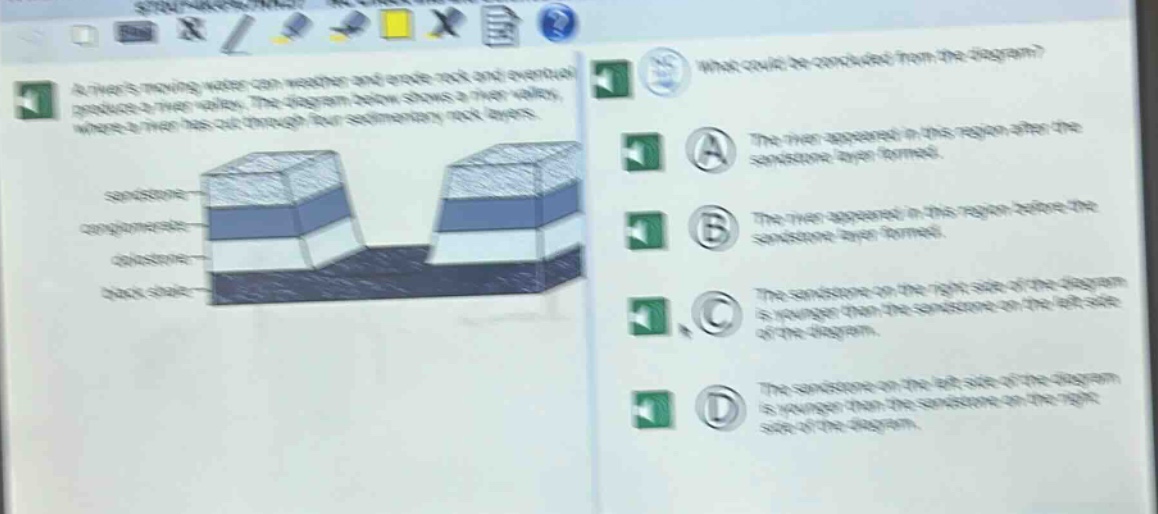
a rivers moving water can weather and erode rock and eventually produce a river valley. the diagram below shows a river valley, where a river has cut through four sedimentary rock layers. what could be concluded from the diagram? a the river appeared in this region after the sandstone layer formed. b the river appeared in this region before the sandstone layer formed. c the sandstone on the right - side of the diagram is younger than the sandstone on the left - side of the diagram. d the sandstone on the left - side of the diagram is younger than the sandstone on the right - side of the diagram.
Answer
Brief Explanations:
In geology, the principle of superposition states that in undisturbed sedimentary rock layers, the oldest layers are at the bottom and the youngest are at the top. Here, the river has cut through the rock layers. Since the river cuts through the sand - stone layer, it must have formed after the sand - stone layer.
Answer:
A. The river appeared in this region after the sandstone layer formed.