rock column correlations\nthese three rock columns are found at locations approximately 50 miles apart…
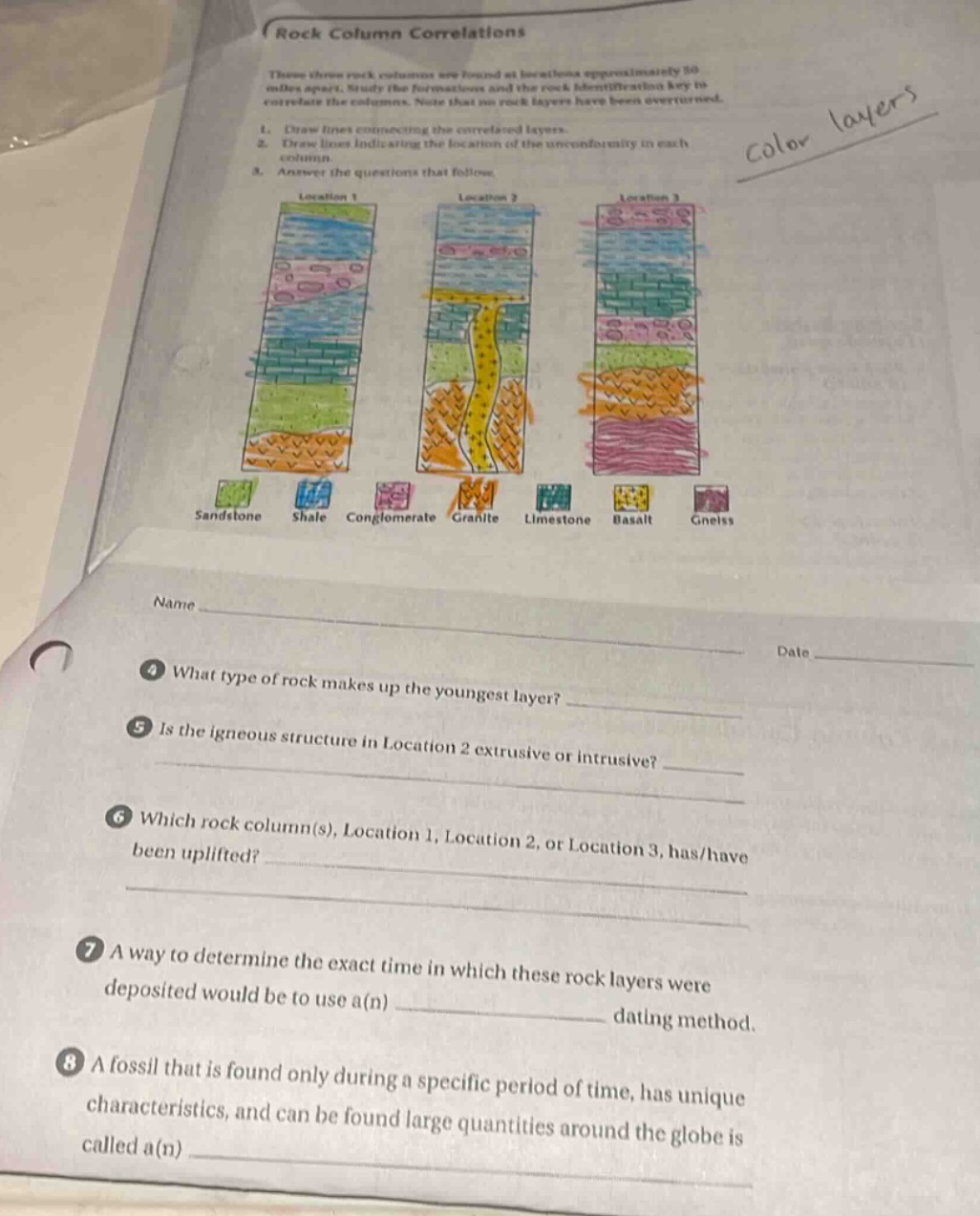
rock column correlations\nthese three rock columns are found at locations approximately 50 miles apart. study the formations and the rock identification key to correlate the columns. note that no rock layers have been overturned.\n1. draw lines connecting the correlated layers.\n2. draw lines indicating the location of the unconformity in each column.\n3. answer the questions that follow.\nname\ndate\n4 what type of rock makes up the youngest layer?\n5 is the igneous structure in location 2 extrusive or intrusive?\n6 which rock column(s), location 1, location 2, or location 3, has/have been uplifted?\n7 a way to determine the exact time in which these rock layers were deposited would be to use a(n) ______________ dating method.\n8 a fossil that is found only during a specific period of time, has unique characteristics, and can be found large quantities around the globe is called a(n) ______________
Answer
Explanation:
Step1: Analyze rock - layer order
In geology, the principle of superposition states that in an undisturbed sequence of sedimentary rocks, the youngest layer is on top. In the given rock - columns, we observe the top - most layers.
Step2: Identify rock types
The top - most layer in Location 1 is shale, in Location 2 is basalt (an igneous rock), and in Location 3 is conglomerate. Among these, basalt is the youngest as it is formed from recent volcanic activity in many cases compared to sedimentary rocks like shale and conglomerate.
Step3: Determine igneous rock type in Location 2
The igneous structure in Location 2 is a vertical feature cutting through other rock layers. Intrusive igneous rocks form when magma cools and solidifies below the Earth's surface. Extrusive igneous rocks form when lava cools on the Earth's surface. Since the igneous structure in Location 2 is within the rock layers (not on the surface), it is intrusive.
Step4: Check for uplift
Uplift is indicated by tilted or deformed rock layers. Location 2 shows a tilted igneous structure and deformed sedimentary layers around it, suggesting uplift. Locations 1 and 3 have relatively horizontal layers.
Step5: Recall dating methods
To determine the exact time of rock - layer deposition, radiometric dating is used. It measures the decay of radioactive isotopes in rocks to calculate their age.
Step6: Define the fossil type
A fossil that is found only during a specific period of time, has unique characteristics, and can be found in large quantities around the globe is called an index fossil.
Answer:
- Basalt
- Intrusive
- Location 2
- Radiometric
- Index fossil