scientists are gathering data on the relative ages of rock layers at a location. the picture shows the cross…
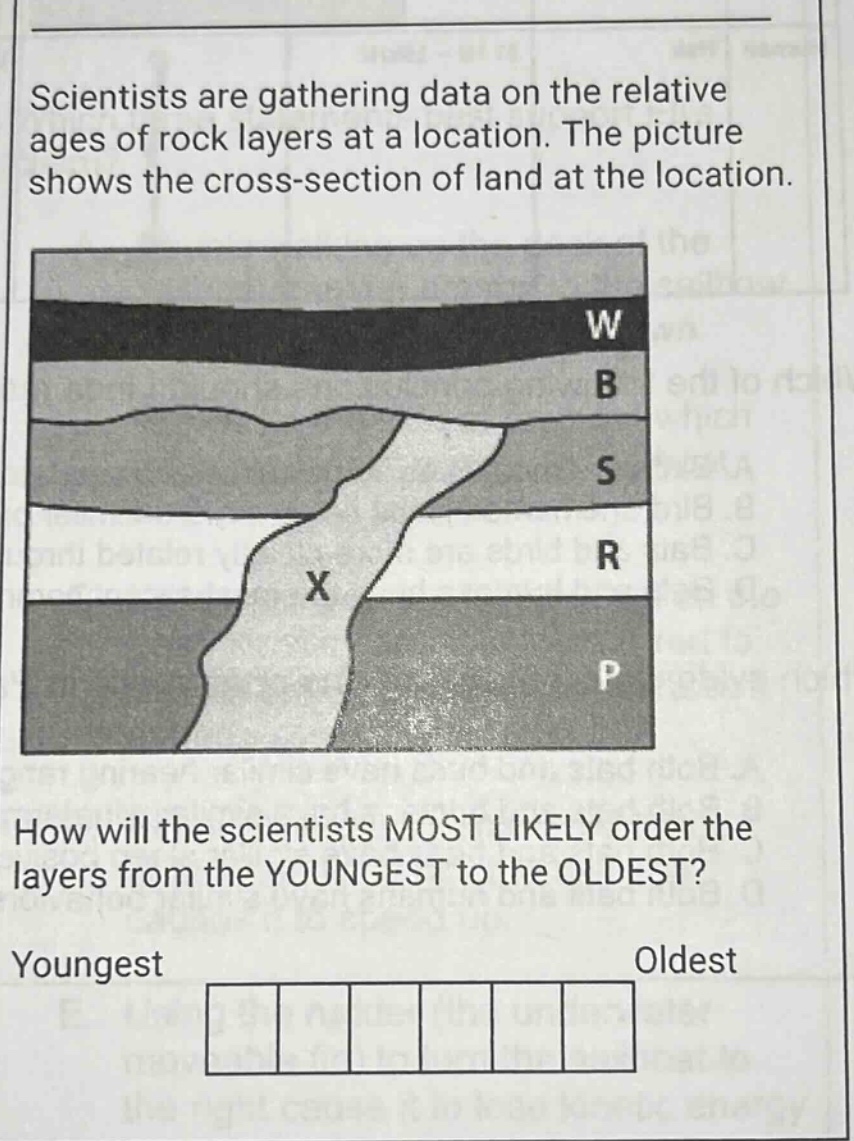
scientists are gathering data on the relative ages of rock layers at a location. the picture shows the cross - section of land at the location. how will the scientists most likely order the layers from the youngest to the oldest? youngest oldest
Answer
Explanation:
Step1: Apply principle of superposition
In undisturbed rock - layer sequences, the oldest layers are at the bottom and the youngest are at the top. Also, a rock or intrusion that cuts through other rocks is younger than the rocks it cuts through.
Step2: Identify youngest layer
Layer W is at the top of the sequence and is not cut by any other feature, so it is the youngest.
Step3: Identify next - youngest layer
Layer B is below W and is not cut by any feature other than W (by superposition), so it is the second - youngest.
Step4: Identify third - youngest layer
Layer S is below B and is cut by intrusion X. So, S is the third - youngest.
Step5: Identify fourth - youngest layer
Intrusion X cuts through S, R, and P, so it is younger than these layers but older than W and B. So, X is the fourth - youngest.
Step6: Identify fifth - youngest layer
Layer R is below S and is cut by X, so it is the fifth - youngest.
Step7: Identify oldest layer
Layer P is at the bottom of the sequence and is cut by X, so it is the oldest.
Answer:
W, B, S, X, R, P