section i\ndirections\nthe following passages are given.\n(1) while many people are familiar with the dewey…
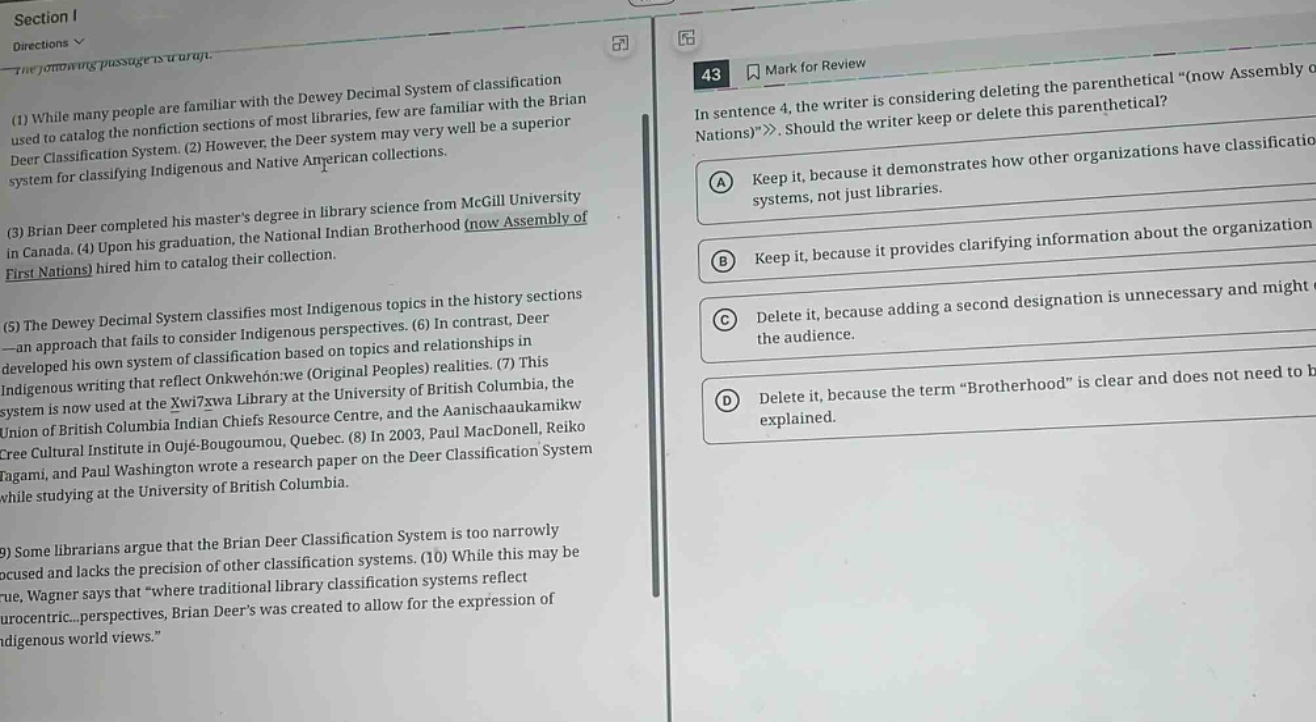
section i\ndirections\nthe following passages are given.\n(1) while many people are familiar with the dewey decimal system of classification used to catalog the nonfiction sections of most libraries, few are familiar with the brian deer classification system. (2) however, the deer system may very well be a superior system for classifying indigenous and native american collections.\n(3) brian deer completed his masters degree in library science from mcgill university in canada. (4) upon his graduation, the national indian brotherhood (now assembly of first nations) hired him to catalog their collection.\n(5) the dewey decimal system classifies most indigenous topics in the history sections - an approach that fails to consider indigenous perspectives. (6) in contrast, deer developed his own system of classification based on topics and relationships in indigenous writing that reflect onkwehon:we (original peoples) realities. (7) this system is now used at the xwi7xwa library at the university of british columbia, the union of british columbia indian chiefs resource centre, and the aanischaaukamikw cree cultural institute in oujé - bougoumou, quebec. (8) in 2003, paul macdonell, reiko tagami, and paul washington wrote a research paper on the deer classification system while studying at the university of british columbia.\n(9) some librarians argue that the brian deer classification system is too narrowly focused and lacks the precision of other classification systems. (10) while this may be true, wagner says that “where traditional library classification systems reflect eurocentric... perspectives, brian deers was created to allow for the expression of indigenous world views.”\n43 mark for review\nin sentence 4, the writer is considering deleting the parenthetical “(now assembly of nations)”. should the writer keep or delete this parenthetical?\na keep it, because it demonstrates how other organizations have classification systems, not just libraries.\nb keep it, because it provides clarifying information about the organization.\nc delete it, because adding a second designation is unnecessary and might confuse the audience.\nd delete it, because the term “brotherhood” is clear and does not need to be explained.
Answer
Brief Explanations:
The parenthetical "(now Assembly of First Nations)" provides clarifying information about the change in the organization's name. It helps the reader understand the historical - present context of the organization that hired Brian Deer. Without this information, the reader might be confused about the two different names for what is essentially the same organization.
Answer:
B. Keep it, because it provides clarifying information about the organization.