section 4: python code analysis & interpretation (25 points)\nanalyze the following python code snippets and…
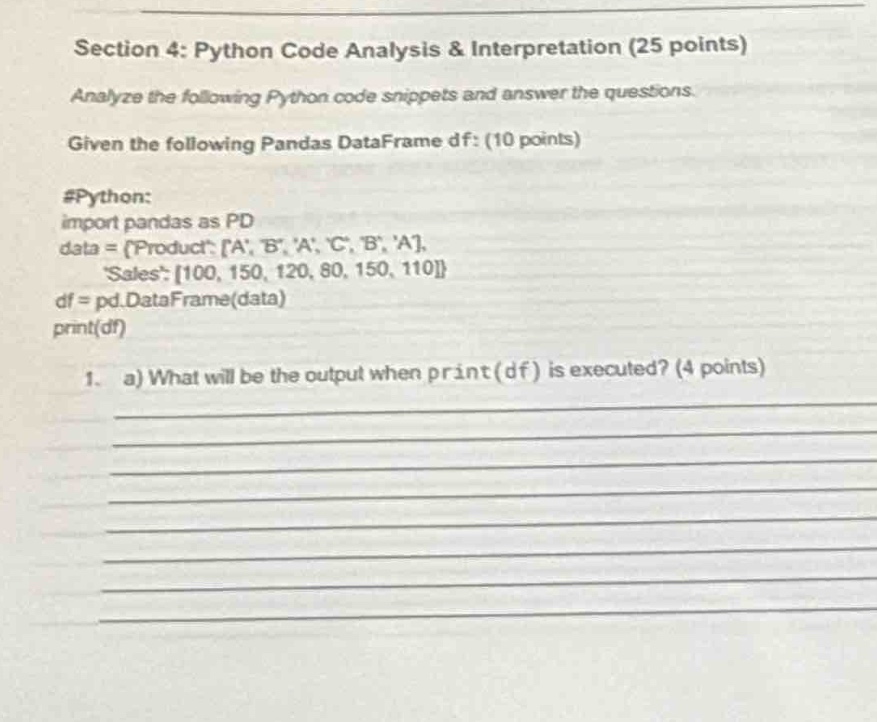
section 4: python code analysis & interpretation (25 points)\nanalyze the following python code snippets and answer the questions.\ngiven the following pandas dataframe df: (10 points)\n#python:\nimport pandas as pd\ndata = {product: a, b, a, c, b, a,\n sales: 100, 150, 120, 80, 150, 110}\ndf = pd.dataframe(data)\nprint(df)\n1. a) what will be the output when print(df) is executed? (4 points)
Answer
Explanation:
Step1: Analizar la creación del DataFrame
El código importa la librería pandas como pd y crea un diccionario data con dos listas, una para los nombres de productos y otra para las ventas. Luego, crea un DataFrame df a partir de ese diccionario.
Step2: Determinar el output
Al ejecutar print(df), se mostrará el DataFrame con dos columnas (Product y Sales) y 6 filas.
Answer:
  Product  Sales
0       A    100
1       B    150
2       A    120
3       C     80
4       B    150
5       A    110