the seven commandments 1 whatever goes upon two legs is an enemy. 2 whatever goes upon four legs, or has…
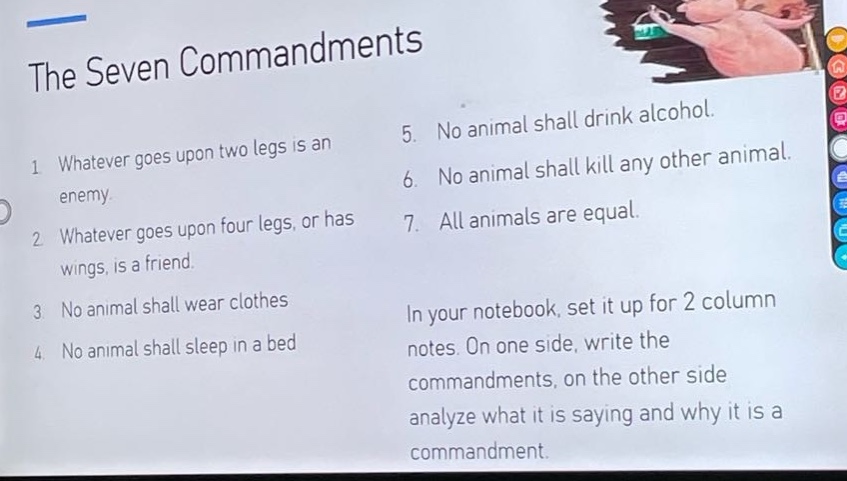
the seven commandments 1 whatever goes upon two legs is an enemy. 2 whatever goes upon four legs, or has wings, is a friend. 3 no animal shall wear clothes 4 no animal shall sleep in a bed 5 no animal shall drink alcohol. 6 no animal shall kill any other animal. 7 all animals are equal. in your notebook, set it up for 2 column notes. on one side, write the commandments, on the other side analyze what it is saying and why it is a commandment.
Answer
Brief Explanations:
- This rule creates a clear - cut enemy category based on locomotion. It helps in uniting animals against a common perceived enemy.
- Defines friends by their physical form, promoting unity among animals with similar physical characteristics.
- Clothes are seen as a human - like trait, and this commandment reinforces the idea of animal distinctiveness from humans.
- Beds are also associated with human comfort, and this rule maintains the separation between animal and human lifestyles.
- Alcohol is a human vice, and this rule keeps animals from adopting human - like vices.
- Promotes peace and non - violence within the animal community.
- Establishes an ideal of equality among all animals, which is a fundamental principle for a harmonious animal society.
Answer:
- Commandment: Whatever goes upon two legs is an enemy. Analysis: Distinguishes enemies based on locomotion to unite animals.
- Commandment: Whatever goes upon four legs, or has wings, is a friend. Analysis: Defines friends by physical form for unity.
- Commandment: No animal shall wear clothes. Analysis: Reinforces animal distinctiveness from humans.
- Commandment: No animal shall sleep in a bed. Analysis: Maintains separation from human lifestyles.
- Commandment: No animal shall drink alcohol. Analysis: Keeps animals from human vices.
- Commandment: No animal shall kill any other animal. Analysis: Promotes peace in the animal community.
- Commandment: All animals are equal. Analysis: Establishes a principle of equality for harmony.