study the graph, and answer the following questions on a separate sheet of paper. 1. how are the moon’s…
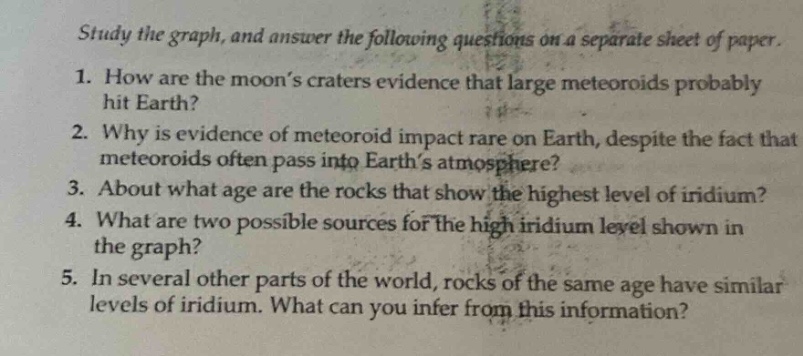
study the graph, and answer the following questions on a separate sheet of paper. 1. how are the moon’s craters evidence that large meteoroids probably hit earth? 2. why is evidence of meteoroid impact rare on earth, despite the fact that meteoroids often pass into earth’s atmosphere? 3. about what age are the rocks that show the highest level of iridium? 4. what are two possible sources for the high iridium level shown in the graph? 5. in several other parts of the world, rocks of the same age have similar levels of iridium. what can you infer from this information?
Answer
Answer:
- The moon has no atmosphere or significant geological processes to erase craters. Since the moon and Earth are in the same solar - system environment, if large meteoroids hit the moon, it is likely they also hit Earth.
- Earth has an atmosphere that causes most meteoroids to burn up before reaching the surface. Also, geological processes like erosion, volcanic activity, and plate tectonics can destroy or cover up impact evidence.
- Without seeing the graph, it's impossible to give a specific age. But generally, the rocks with the highest iridium levels are associated with the Cretaceous - Paleogene (K - Pg) boundary, which is about 66 million years ago.
- One possible source is a large asteroid or comet impact. Another could be volcanic activity that brought iridium from the Earth's mantle to the surface.
- It suggests that the high iridium levels were likely caused by a global event, such as a large - scale meteoroid impact that affected the entire planet simultaneously.
Brief Explanations:
- Similar solar - system exposure.
- Atmosphere and geological processes.
- Associated with K - Pg boundary.
- Impact and volcanic activity.
- Indicates a global event.