table 9.1 the distribution of hiv/aids around the world, end of 2000\nregion adults and children living with…
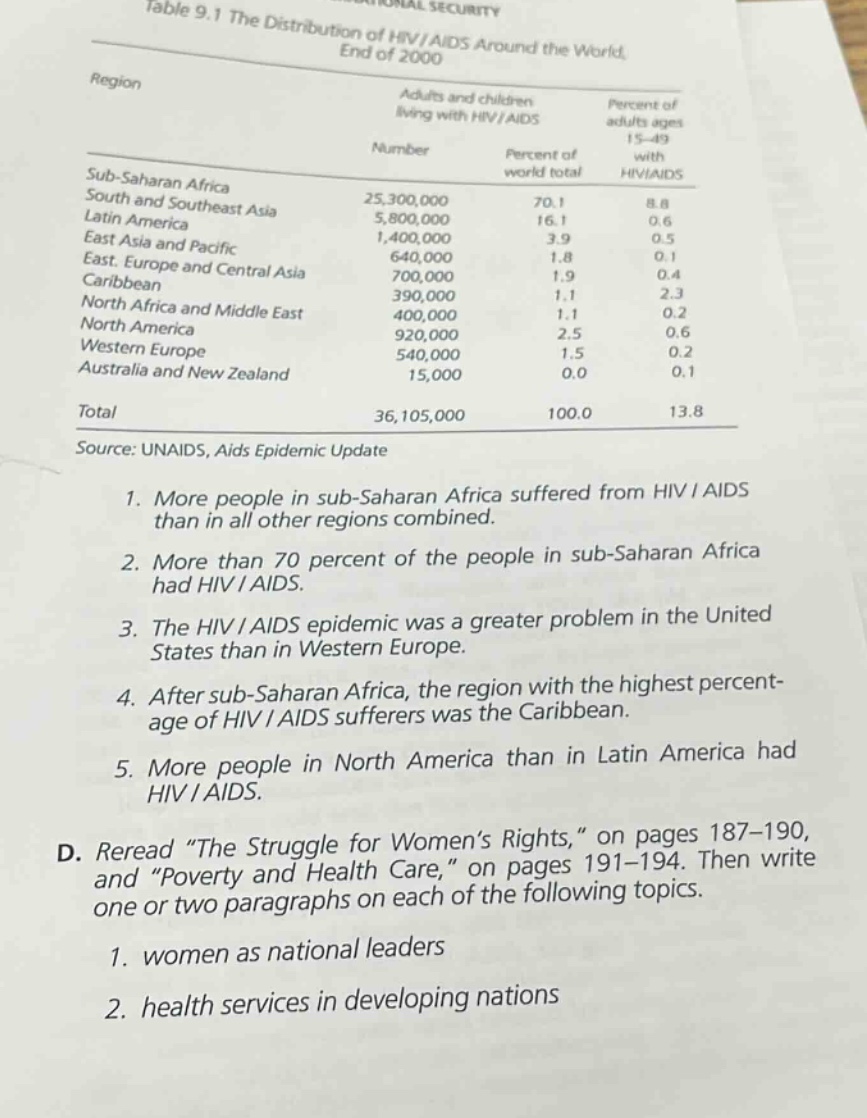
table 9.1 the distribution of hiv/aids around the world, end of 2000\nregion adults and children living with hiv/aids percent of adults ages 15 - 49 with hiv/aids\nnumber percent of world total\nsub - saharan africa 25,300,000 70.1 8.8\nsouth and southeast asia 5,800,000 16.1 0.6\nlatin america 1,400,000 3.9 0.5\neast asia and pacific 640,000 1.8 0.1\neast, europe and central asia 700,000 1.9 0.4\ncaribbean 390,000 1.1 2.3\nnorth africa and middle east 400,000 1.1 0.2\nnorth america 920,000 2.5 0.6\nwestern europe 540,000 1.5 0.2\naustralia and new zealand 15,000 0.0 0.1\ntotal 36,105,000 100.0 13.8\nsource: unaids, aids epidemic update\n1. more people in sub - saharan africa suffered from hiv/aids than in all other regions combined.\n2. more than 70 percent of the people in sub - saharan africa had hiv/aids.\n3. the hiv/aids epidemic was a greater problem in the united states than in western europe.\n4. after sub - saharan africa, the region with the highest percentage of hiv/aids sufferers was the caribbean.\n5. more people in north america than in latin america had hiv/aids.\nd. reread “the struggle for women’s rights,” on pages 187 - 190, and “poverty and health care,” on pages 191 - 194. then write one or two paragraphs on each of the following topics.\n1. women as national leaders\n2. health services in developing nations
Answer
Brief Explanations:
The number of adults and children living with HIV/AIDS in Sub - Saharan Africa is 25,300,000, which is more than half of the world total of 36,105,000. The sum of those in other regions is less than that in Sub - Saharan Africa.
Answer: True
Brief Explanations:
The table shows the percentage of adults ages 15 - 49 with HIV/AIDS in Sub - Saharan Africa is 8.8%, not more than 70%. The 70.1% is the percent of world total living with HIV/AIDS in Sub - Saharan Africa.
Answer: False
Brief Explanations:
North America is given in the table but the United States is not separately listed. We can't compare the US and Western Europe based on the given data.
Answer: False (due to lack of data)
Brief Explanations:
Among the regions, after Sub - Saharan Africa, the Caribbean has a relatively high percentage (2.3%) of adults ages 15 - 49 with HIV/AIDS compared to other regions.
Answer: True
Brief Explanations:
The number of people with HIV/AIDS in North America is 920,000 and in Latin America is 1,800,000. So more people in Latin America have HIV/AIDS.
Answer: False
For the writing part: 1.
Brief Explanations:
When discussing women as national leaders, one can consider historical examples like Indira Gandhi, Benazir Bhutto etc. Analyze their leadership styles, the challenges they faced due to gender - bias, and the impact they made on their countries in terms of social, economic and political development.
Answer: Write one or two paragraphs considering historical examples, challenges and impacts of women as national leaders.
Brief Explanations:
For health services in developing nations, one can discuss issues like lack of resources, inadequate infrastructure, shortage of trained medical personnel. Also, mention any initiatives taken to improve the situation such as international aid programs and local health - care reforms.