the table shows the estimated number of lines of code written by computer programmers per hour when x people…
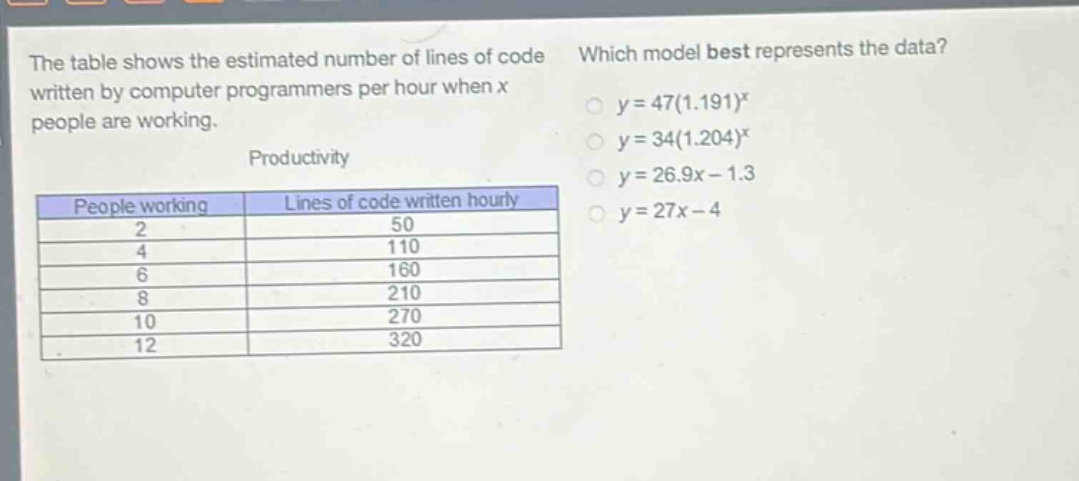
the table shows the estimated number of lines of code written by computer programmers per hour when x people are working.\nproductivity\n| people working | lines of code written hourly |\n| ---- | ---- |\n| 2 | 50 |\n| 4 | 110 |\n| 6 | 160 |\n| 8 | 210 |\n| 10 | 270 |\n| 12 | 320 |\nwhich model best represents the data?\n$y = 47(1.191)^x$\n$y = 34(1.204)^x$\n$y = 26.9x - 1.3$\n$y = 27x - 4$
Answer
Explanation:
Step1: Check linear models
For the linear models $y = 26.9x - 1.3$ and $y=27x - 4$, we can substitute the values of $x$ from the table and check the $y -$values. When $x = 2$ for $y = 26.9x - 1.3$, $y=26.9\times2-1.3=53.8 - 1.3=52.5$. When $x = 2$ for $y = 27x - 4$, $y=27\times2-4=54 - 4 = 50$. When $x = 4$ for $y = 27x - 4$, $y=27\times4-4=108 - 4=104$. When $x = 4$ for $y = 26.9x - 1.3$, $y=26.9\times4-1.3=107.6-1.3 = 106.3$.
Step2: Check exponential models
For the exponential model $y = 47(1.191)^x$, when $x = 2$, $y=47\times(1.191)^2=47\times1.418481\approx66.67$. For the exponential model $y = 34(1.204)^x$, when $x = 2$, $y=34\times(1.204)^2=34\times1.449616\approx49.29$. When $x = 4$, $y=34\times(1.204)^4=34\times2.09299\approx71.16$. As we substitute more values of $x$ from the table, we find that the linear model $y = 27x - 4$ gives values that are closest to the values in the table.
Answer:
$y = 27x - 4$