the table shows the estimated number of lines of code written by computer programmers per hour when x people…
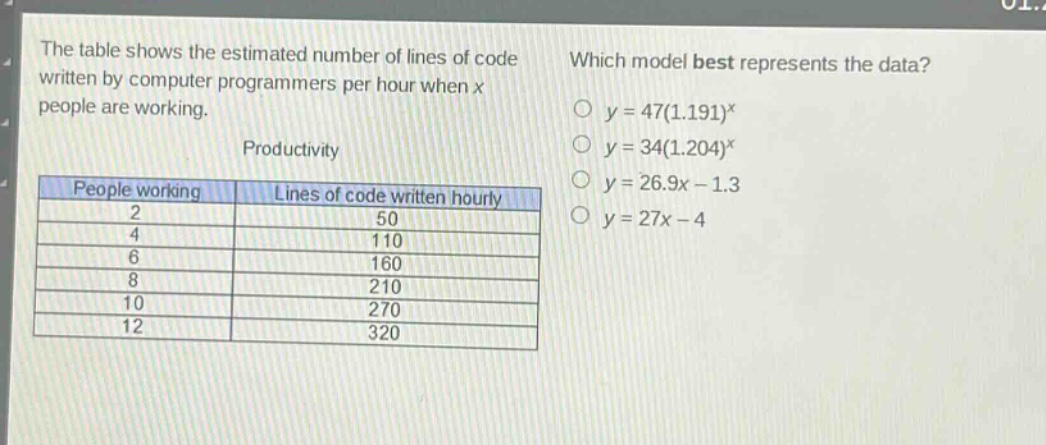
the table shows the estimated number of lines of code written by computer programmers per hour when x people are working. which model best represents the data? productivity\n| people working | lines of code written hourly |\n| ---- | ---- |\n| 2 | 50 |\n| 4 | 110 |\n| 6 | 160 |\n| 8 | 210 |\n| 10 | 270 |\n| 12 | 320 |\no y = 47(1.191)^x\no y = 34(1.204)^x\no y = 26.9x - 1.3\no y = 27x - 4
Answer
Explanation:
Step1: Check linear models
For a linear model $y = mx + b$, we can find the slope $m$ between two points $(x_1,y_1)$ and $(x_2,y_2)$ using the formula $m=\frac{y_2 - y_1}{x_2 - x_1}$. Let's take the first two points $(2,50)$ and $(4,110)$. The slope $m=\frac{110 - 50}{4 - 2}=\frac{60}{2}=30$. For the model $y = 26.9x-1.3$, when $x = 2$, $y=26.9\times2-1.3=53.8 - 1.3 = 52.5$. When $x = 4$, $y=26.9\times4-1.3=107.6-1.3 = 106.3$. For the model $y = 27x - 4$, when $x = 2$, $y=27\times2-4=54 - 4=50$, when $x = 4$, $y=27\times4-4=108 - 4 = 104$. The linear - models do not fit the data well.
Step2: Check exponential models
For an exponential model $y = a(b)^x$. Let's take the first point $(x = 2,y = 50)$ for $y = 47(1.191)^x$. When $x = 2$, $y=47\times(1.191)^2=47\times1.418481\approx66.67$. For $y = 34(1.204)^x$, when $x = 2$, $y=34\times(1.204)^2=34\times1.449616\approx49.29$. Let's calculate the relative errors for all models at multiple points. For the exponential model $y = 34(1.204)^x$: When $x = 2$, $y=34\times(1.204)^2=34\times1.449616 = 49.287$; when $x = 4$, $y=34\times(1.204)^4=34\times2.16099\approx73.47$; when $x = 6$, $y=34\times(1.204)^6=34\times3.2177\approx109.4$. For the exponential model $y = 47(1.191)^x$: When $x = 2$, $y = 47\times(1.191)^2=47\times1.418481\approx66.67$; when $x = 4$, $y=47\times(1.191)^4=47\times2.0117\approx94.55$. We can also use a graphing utility or calculate the residuals (the differences between the observed $y$ - values and the predicted $y$ - values). By calculating the residuals for all the data points, we find that the model $y = 34(1.204)^x$ gives the best fit.
Answer:
$y = 34(1.204)^x$