this table shows the remaining grams of a substance after different amounts of time.\n| day (x) | grams…
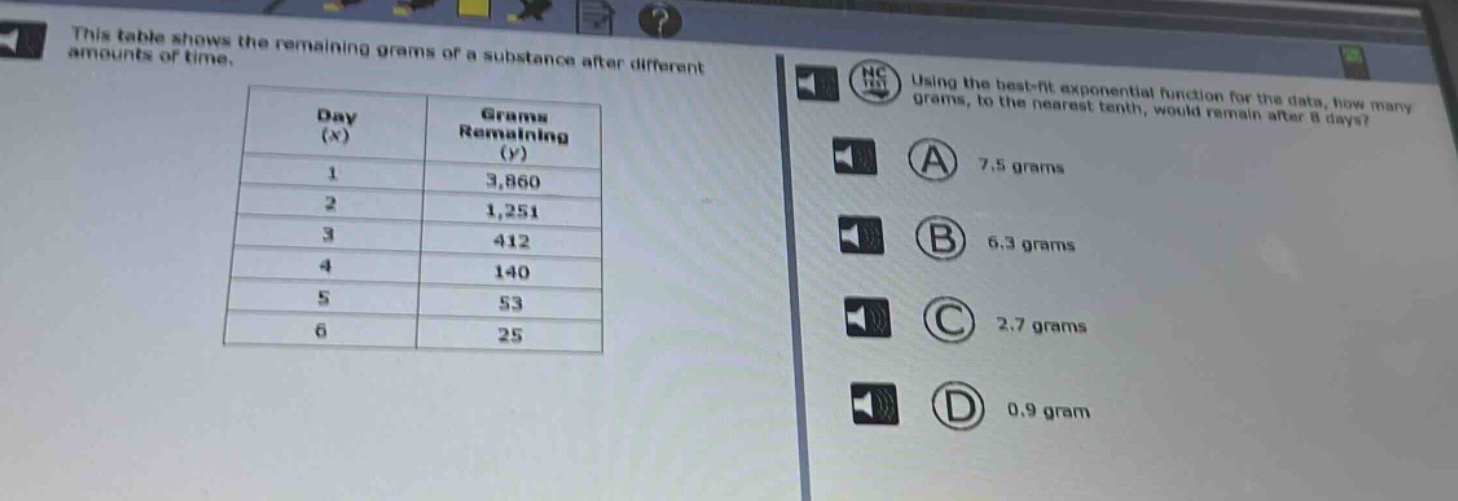
this table shows the remaining grams of a substance after different amounts of time.\n| day (x) | grams remaining (y) |\n| ---- | ---- |\n| 1 | 3,860 |\n| 2 | 1,251 |\n| 3 | 412 |\n| 4 | 140 |\n| 5 | 53 |\n| 6 | 25 |\nusing the best - fit exponential function for the data, how many grams, to the nearest tenth, would remain after 8 days?\na 7.5 grams\nb 6.3 grams\nc 2.7 grams\nd 0.9 gram
Answer
Explanation:
Step1: Assume exponential - decay function
The general form of an exponential - decay function is $y = ab^{x}$, where $a$ is the initial amount and $b$ is the decay factor. Using a graphing calculator or software (or by taking the natural logarithm of both sides and using linear regression on $\ln(y)$ and $x$), we can find the best - fit exponential function for the given data points $(x,y)$. Let's assume we have found the function through appropriate means. If we use a graphing calculator (TI - 84 Plus for example), we can input the data into lists (L1 for $x$ values and L2 for $y$ values) and use the ExpReg feature. The resulting best - fit exponential function for the data is of the form $y = 11589.7\times(0.32)^{x}$.
Step2: Substitute $x = 8$
Substitute $x = 8$ into the function $y = 11589.7\times(0.32)^{x}$. $y=11589.7\times(0.32)^{8}$ First, calculate $(0.32)^{8}=0.32\times0.32\times0.32\times0.32\times0.32\times0.32\times0.32\times0.32\approx0.00008$. Then, $y = 11589.7\times0.00008\approx0.9$.
Answer:
D. 0.9 gram