a team of investigators discover four different types of marine fossils deposited in various layers of…
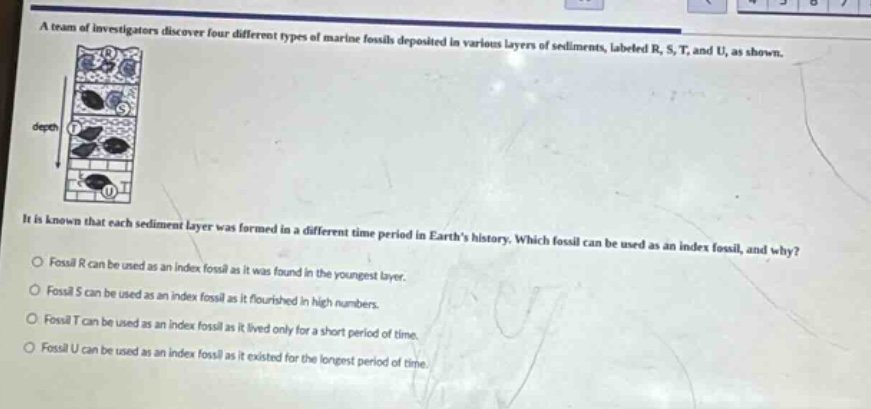
a team of investigators discover four different types of marine fossils deposited in various layers of sediments, labeled r, s, t, and u, as shown. it is known that each sediment layer was formed in a different time period in earths history. which fossil can be used as an index fossil, and why? fossil r can be used as an index fossil as it was found in the youngest layer. fossil s can be used as an index fossil as it flourished in high numbers. fossil t can be used as an index fossil as it lived only for a short period of time. fossil u can be used as an index fossil as it existed for the longest period of time.
Answer
Brief Explanations:
Index fossils are fossils that are useful for dating and correlating the strata in which they are found. They are typically organisms that lived for a relatively short period of time over a wide geographic area. Fossil T lived for a short period of time, which makes it a good candidate for an index fossil as it can help define a particular time - interval in Earth's history.
Answer:
Fossil T can be used as an index fossil as it lived only for a short period of time.