how has technology affected the curiosity rovers mission to study the surface of mars? check all that…
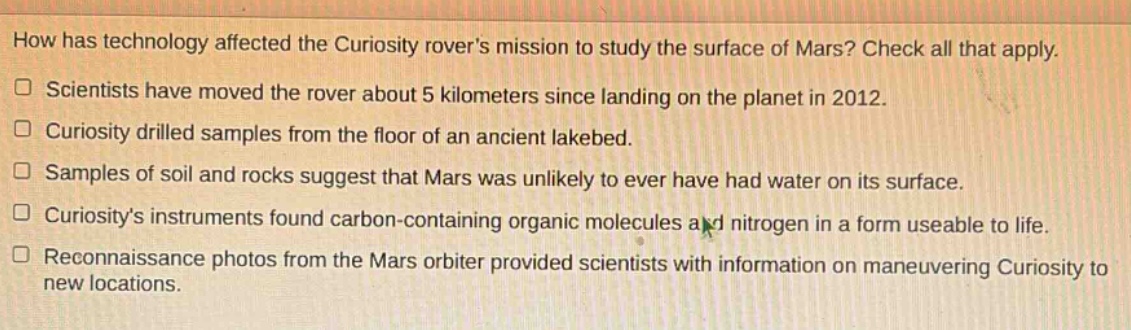
how has technology affected the curiosity rovers mission to study the surface of mars? check all that apply.\n□ scientists have moved the rover about 5 kilometers since landing on the planet in 2012.\n□ curiosity drilled samples from the floor of an ancient lakebed.\n□ samples of soil and rocks suggest that mars was unlikely to ever have had water on its surface.\n□ curiositys instruments found carbon - containing organic molecules and nitrogen in a form useable to life.\n□ reconnaissance photos from the mars orbiter provided scientists with information on maneuvering curiosity to new locations.
Answer
Answer:
- Scientists have moved the rover about 5 kilometers since landing on the planet in 2012.
- Curiosity drilled samples from the floor of an ancient lakebed.
- Curiosity's instruments found carbon - containing organic molecules and nitrogen in a form useable to life.
- Reconnaissance photos from the Mars orbiter provided scientists with information on maneuvering Curiosity to new locations.
Brief Explanations:
These statements describe how technology (rover movement, drilling, instruments, orbiter photos) has enabled and advanced the Curiosity rover's Mars - study mission. The statement about Mars being unlikely to have had water is incorrect as evidence from Curiosity suggests otherwise.