when testing flameless heater designs, why is it important to conduct tests based on specific criteria and…
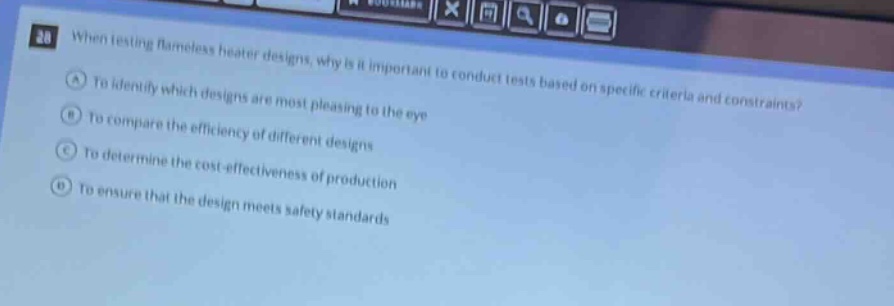
when testing flameless heater designs, why is it important to conduct tests based on specific criteria and constraints?\na to identify which designs are most pleasing to the eye\nb to compare the efficiency of different designs\nc to determine the cost - effectiveness of production\nd to ensure that the design meets safety standards
Answer
Brief Explanations:
Testing flameless heater designs based on criteria and constraints mainly aims to assess and compare their performance aspects. Efficiency is a key performance - related factor. While aesthetic (pleasing to the eye) is not a core engineering test criterion for a heater's functionality. Cost - effectiveness of production is more of a manufacturing - stage consideration rather than a primary reason for testing based on design criteria. Safety standards are usually a set of fixed requirements (not just based on testing criteria and constraints in the sense of comparing different designs). Comparing efficiency across designs is directly related to using specific criteria (like heat output per unit of input) and constraints (such as size limitations) to evaluate the designs.
Answer:
B. To compare the efficiency of different designs