translate each argument into symbolic form. then determine whether the argument is valid or invalid. you may…
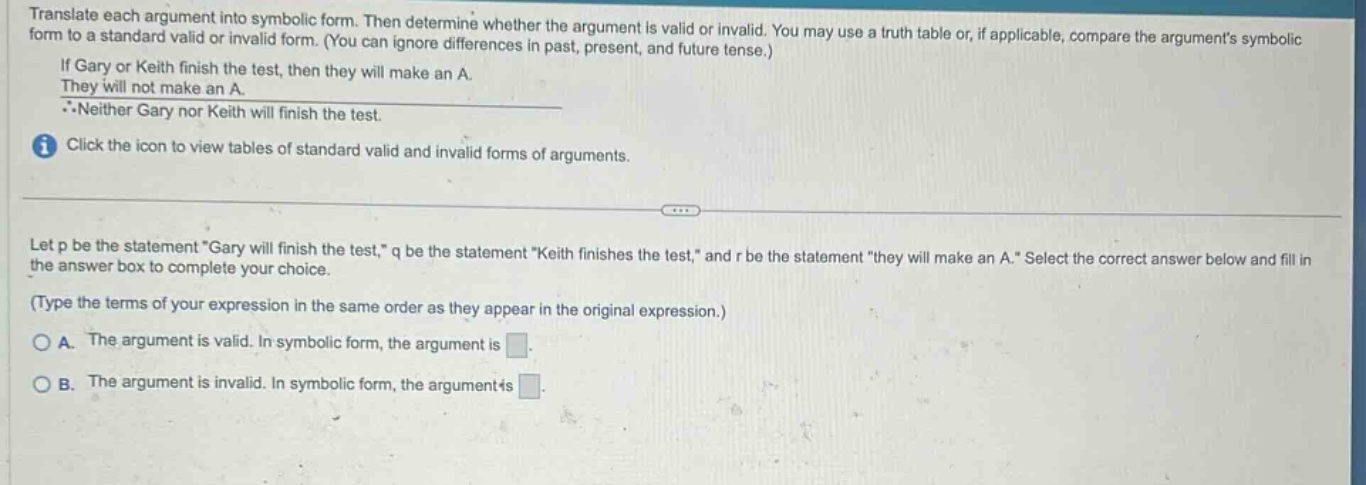
translate each argument into symbolic form. then determine whether the argument is valid or invalid. you may use a truth table or, if applicable, compare the arguments symbolic form to a standard valid or invalid form. (you can ignore differences in past, present, and future tense.) if gary or keith finish the test, then they will make an a. they will not make an a. ∴neither gary nor keith will finish the test. click the icon to view tables of standard valid and invalid forms of arguments. let p be the statement “gary will finish the test,” q be the statement “keith finishes the test,” and r be the statement “they will make an a.” select the correct answer below and fill in the answer box to complete your choice. (type the terms of your expression in the same order as they appear in the original expression.) a. the argument is valid. in symbolic form, the argument is. b. the argument is invalid. in symbolic form, the argument is.
Answer
Explanation:
Step1: Translate statements to symbols
The first statement "If Gary or Keith finish the test, then they will make an A" can be written as $(p\vee q)\to r$. The second statement "They will not make an A" is $\neg r$. The third statement "Neither Gary nor Keith will finish the test" is $\neg p\wedge\neg q$. So the argument in symbolic - form is: [ \begin{align*} (p\vee q)&\to r\ \neg r&\ \hline \neg p\wedge\neg q& \end{align*} ]
Step2: Apply modus tollens
By modus tollens, from $(p\vee q)\to r$ and $\neg r$, we can conclude $\neg(p\vee q)$.
Step3: Use De - Morgan's law
According to De - Morgan's law, $\neg(p\vee q)=\neg p\wedge\neg q$. So the argument is valid.
Answer:
A. The argument is valid. In symbolic form, the argument is ((p\vee q)\to r,\neg r\therefore\neg p\wedge\neg q)