1. a two - digit counting number has a value that is 8 times the sum of its digits. if 6 times the units’…
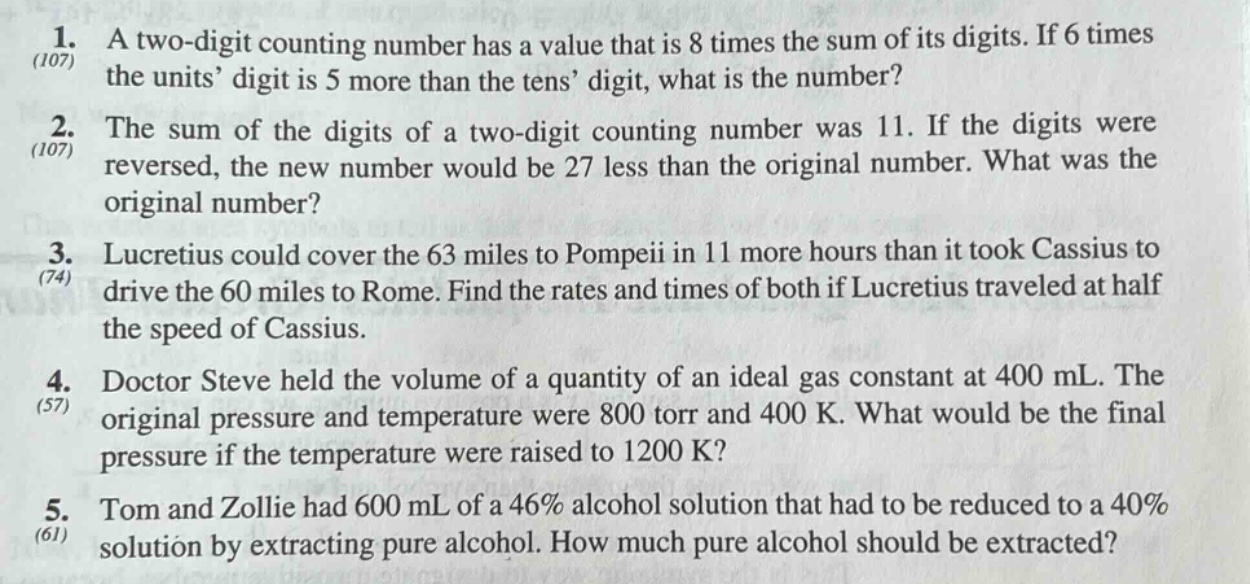
1. a two - digit counting number has a value that is 8 times the sum of its digits. if 6 times the units’ digit is 5 more than the tens’ digit, what is the number?\n2. the sum of the digits of a two - digit counting number was 11. if the digits were reversed, the new number would be 27 less than the original number. what was the original number?\n3. lucretius could cover the 63 miles to pompeii in 11 more hours than it took cassius to drive the 60 miles to rome. find the rates and times of both if lucretius traveled at half the speed of cassius.\n4. doctor steve held the volume of a quantity of an ideal gas constant at 400 ml. the original pressure and temperature were 800 torr and 400 k. what would be the final pressure if the temperature were raised to 1200 k?\n5. tom and zollie had 600 ml of a 46% alcohol solution that had to be reduced to a 40% solution by extracting pure alcohol. how much pure alcohol should be extracted?
Answer
1.
Explanation:
Step1: Let the tens - digit be $x$ and the units - digit be $y$.
The two - digit number can be written as $10x + y$. We are given two equations: Equation 1: $10x + y=8(x + y)$; Equation 2: $6y=x + 5$. From Equation 1: [ \begin{align*} 10x + y&=8x + 8y\ 10x-8x&=8y - y\ 2x&=7y\ x&=\frac{7y}{2} \end{align*} ]
Step2: Substitute $x=\frac{7y}{2}$ into Equation 2.
[ \begin{align*} 6y&=\frac{7y}{2}+ 5\ 6y-\frac{7y}{2}&=5\ \frac{12y - 7y}{2}&=5\ \frac{5y}{2}&=5\ y&=2 \end{align*} ]
Step3: Find $x$.
Substitute $y = 2$ into $x=\frac{7y}{2}$, we get $x=\frac{7\times2}{2}=7$. The two - digit number is $10x + y=10\times7+2 = 72$.
Answer:
72
2.
Explanation:
Step1: Let the tens - digit be $x$ and the units - digit be $y$.
We have two equations: Equation 1: $x + y=11$ (sum of digits is 11), so $y = 11 - x$. The original number is $10x + y$ and the reversed number is $10y+x$. Equation 2: $10y + x=(10x + y)-27$.
Step2: Substitute $y = 11 - x$ into Equation 2.
[ \begin{align*} 10(11 - x)+x&=(10x+(11 - x))-27\ 110-10x+x&=10x + 11 - x-27\ 110-9x&=9x - 16\ -9x-9x&=-16 - 110\ -18x&=-126\ x&=7 \end{align*} ]
Step3: Find $y$.
Since $y = 11 - x$, when $x = 7$, $y=11 - 7 = 4$. The original number is $10x + y=10\times7 + 4=74$.
Answer:
74
3.
Explanation:
Step1: Let the speed of Cassius be $v$ miles per hour and the time taken by Cassius be $t$ hours.
The speed of Lucretius is $\frac{v}{2}$ miles per hour and the time taken by Lucretius is $t + 11$ hours. We know that distance = speed $\times$ time. For Cassius, $60=vt$. For Lucretius, $63=\frac{v}{2}(t + 11)$. From $60=vt$, we have $v=\frac{60}{t}$.
Step2: Substitute $v=\frac{60}{t}$ into the second - equation.
[ \begin{align*} 63&=\frac{1}{2}\times\frac{60}{t}(t + 11)\ 63&=\frac{30(t + 11)}{t}\ 63t&=30t+330\ 63t-30t&=330\ 33t&=330\ t& = 10 \end{align*} ]
Step3: Find the speeds and times.
For Cassius: $t = 10$ hours, $v=\frac{60}{10}=6$ miles per hour. For Lucretius: $t_{L}=t + 11=10 + 11 = 21$ hours, $v_{L}=\frac{v}{2}=3$ miles per hour.
Answer:
Cassius: speed = 6 miles per hour, time = 10 hours; Lucretius: speed = 3 miles per hour, time = 21 hours
4.
Explanation:
Step1: Use the ideal gas law $PV = nRT$. Since the volume $V$ and the amount of gas $n$ are constant, we have $\frac{P_1}{T_1}=\frac{P_2}{T_2}$.
We are given $P_1 = 800$ torr, $T_1 = 400$ K, and $T_2 = 1200$ K.
Step2: Solve for $P_2$.
[ \begin{align*} P_2&=\frac{P_1T_2}{T_1}\ P_2&=\frac{800\times1200}{400}\ P_2&=2400\text{ torr} \end{align*} ]
Answer:
2400 torr
5.
Explanation:
Step1: Find the initial amount of alcohol.
The initial volume of the solution is $V_1 = 600$ mL and the initial percentage of alcohol is $46%$. So the initial amount of alcohol is $0.46\times600 = 276$ mL. Let the volume of alcohol to be extracted be $x$ mL. The new volume of the solution is $V_2=600 - x$ mL and the new percentage of alcohol is $40%$. The new amount of alcohol is $0.4(600 - x)$ mL.
Step2: Set up an equation based on the amount of alcohol.
The initial amount of alcohol minus the amount of alcohol extracted is equal to the new amount of alcohol. So $276-x=0.4(600 - x)$. [ \begin{align*} 276-x&=240-0.4x\ -x + 0.4x&=240 - 276\ -0.6x&=-36\ x&=60 \end{align*} ]
Answer:
60 mL