1. what two elements made up earths most primitive atmosphere?\n2. earths primitive atmosphere was similar…
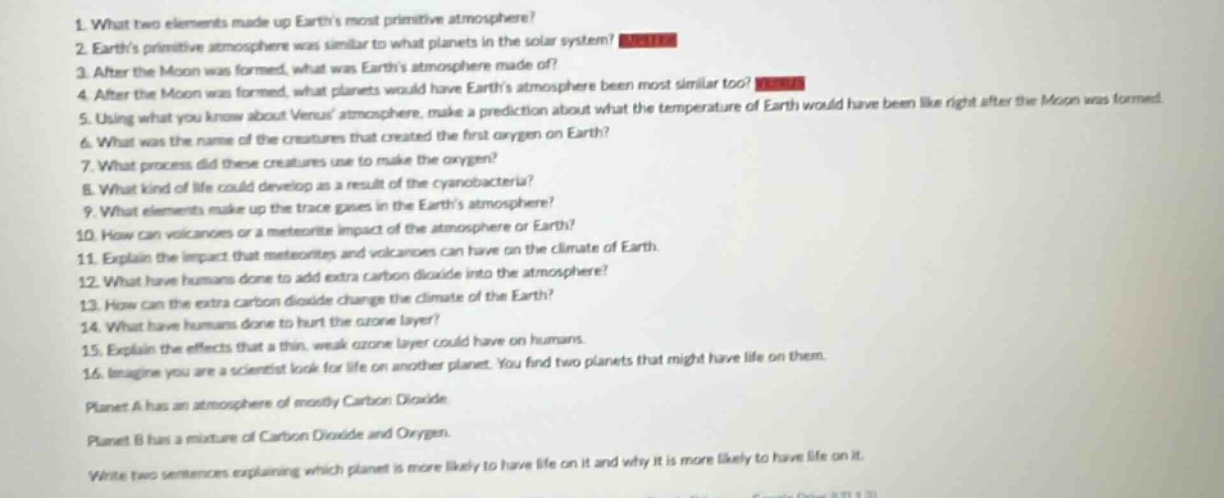
1. what two elements made up earths most primitive atmosphere?\n2. earths primitive atmosphere was similar to what planets in the solar system?\n3. after the moon was formed, what was earths atmosphere made of?\n4. after the moon was formed, what planets would have earths atmosphere been most similar too?\n5. using what you know about venus atmosphere, make a prediction about what the temperature of earth would have been like right after the moon was formed.\n6. what was the name of the creatures that created the first oxygen on earth?\n7. what process did these creatures use to make the oxygen?\n8. what kind of life could develop as a result of the cyanobacteria?\n9. what elements make up the trace gases in the earths atmosphere?\n10. how can volcanoes or a meteorite impact the atmosphere or earth?\n11. explain the impact that meteorites and volcanoes can have on the climate of earth.\n12. what have humans done to add extra carbon dioxide into the atmosphere?\n13. how can the extra carbon dioxide change the climate of the earth?\n14. what have humans done to thin the ozone layer?\n15. explain the effects that a thin, weak ozone layer could have on humans.\n16. imagine you are a scientist look for life on another planet. you find two planets that might have life on them.\nplanet a has an atmosphere of mostly carbon dioxide.\nplanet b has a mixture of carbon dioxide and oxygen.\nwrite two sentences explaining which planet is more likely to have life on it and why it is more likely to have life on it.
Answer
Brief Explanations:
- Earth's most primitive atmosphere was likely composed of hydrogen and helium.
- It was similar to the gas - giant planets like Jupiter and Saturn in the solar system which are rich in hydrogen and helium.
- After the Moon was formed, Earth's atmosphere was made of water vapor, carbon dioxide, and nitrogen.
- It would have been most similar to Venus which also has a thick atmosphere of carbon - dioxide and water vapor.
- Since Venus has a very high temperature due to its thick carbon - dioxide atmosphere causing a strong greenhouse effect, Earth right after the Moon was formed would likely have been very hot too.
- Cyanobacteria were the creatures that created the first oxygen on Earth.
- They used the process of photosynthesis to make oxygen.
- Complex life forms developed as a result of the oxygen produced by cyanobacteria.
- Trace gases in Earth's atmosphere are made up of elements like argon, neon, methane, etc.
- Volcanoes can release large amounts of gases like sulfur dioxide, carbon dioxide, and water vapor into the atmosphere. Meteorite impacts can also release gases and dust into the atmosphere.
- Meteorites and volcanoes can release large amounts of dust and gases into the atmosphere. Dust can block sunlight causing cooling, while gases like carbon - dioxide can cause warming.
- Humans have burned fossil fuels (coal, oil, and gas) which releases large amounts of carbon - dioxide into the atmosphere.
- Extra carbon - dioxide traps more heat in the Earth's atmosphere, leading to global warming and climate change.
- Humans have contributed to the thinning of the ozone layer by releasing chlorofluorocarbons (CFCs) and other ozone - depleting substances.
- A thin, weak ozone layer could lead to more harmful ultraviolet (UV) radiation reaching the Earth's surface, increasing the risk of skin cancer, cataracts, and harming plants and animals.
- Planet B is more likely to have life on it because oxygen is essential for many forms of life as we know it. The presence of oxygen along with carbon - dioxide provides a more favorable environment for life compared to just carbon - dioxide in Planet A.
Answer:
- Hydrogen and helium
- Jupiter and Saturn
- Water vapor, carbon dioxide, nitrogen
- Venus
- Very hot
- Cyanobacteria
- Photosynthesis
- Complex life forms
- Argon, neon, methane, etc.
- Volcanoes release gases; meteorite impacts release gases and dust
- Dust can cause cooling; gases can cause warming
- Burned fossil fuels
- Traps more heat, causes global warming
- Released CFCs and other ozone - depleting substances
- More UV radiation, increased risk of cancer and harm to life
- Planet B; oxygen is essential for life