two minerals have the same hardness but are different colors. what is the implication?\n○ they may or may…
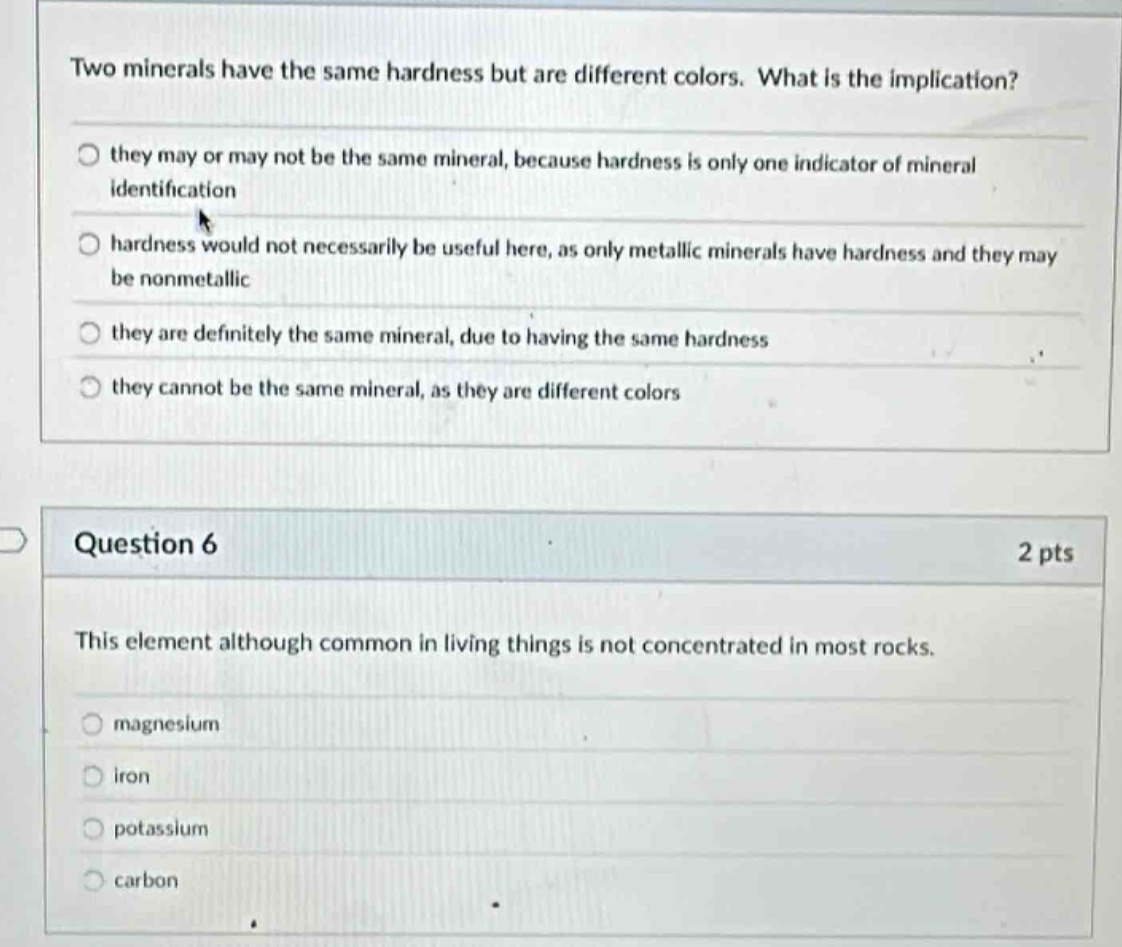
two minerals have the same hardness but are different colors. what is the implication?\n○ they may or may not be the same mineral, because hardness is only one indicator of mineral identification\n○ hardness would not necessarily be useful here, as only metallic minerals have hardness and they may be nonmetallic\n○ they are definitely the same mineral, due to having the same hardness\n○ they cannot be the same mineral, as they are different colors\n\nquestion 6\n2 pts\nthis element although common in living things is not concentrated in most rocks.\n○ magnesium\n○ iron\n○ potassium\n○ carbon
Answer
Brief Explanations:
Mineral identification uses multiple properties. Hardness is one, but color can vary due to impurities. So same - hardness minerals may or may not be the same. Carbon is common in living things and not concentrated in most rocks as it is mainly involved in organic compounds and cycles rather than rock - forming processes.
Answer:
First question: they may or may not be the same mineral, because hardness is only one indicator of mineral identification Second question: carbon