understanding\ncomplete the following questions to demonstrate your understanding of simone de beauvoirs and…
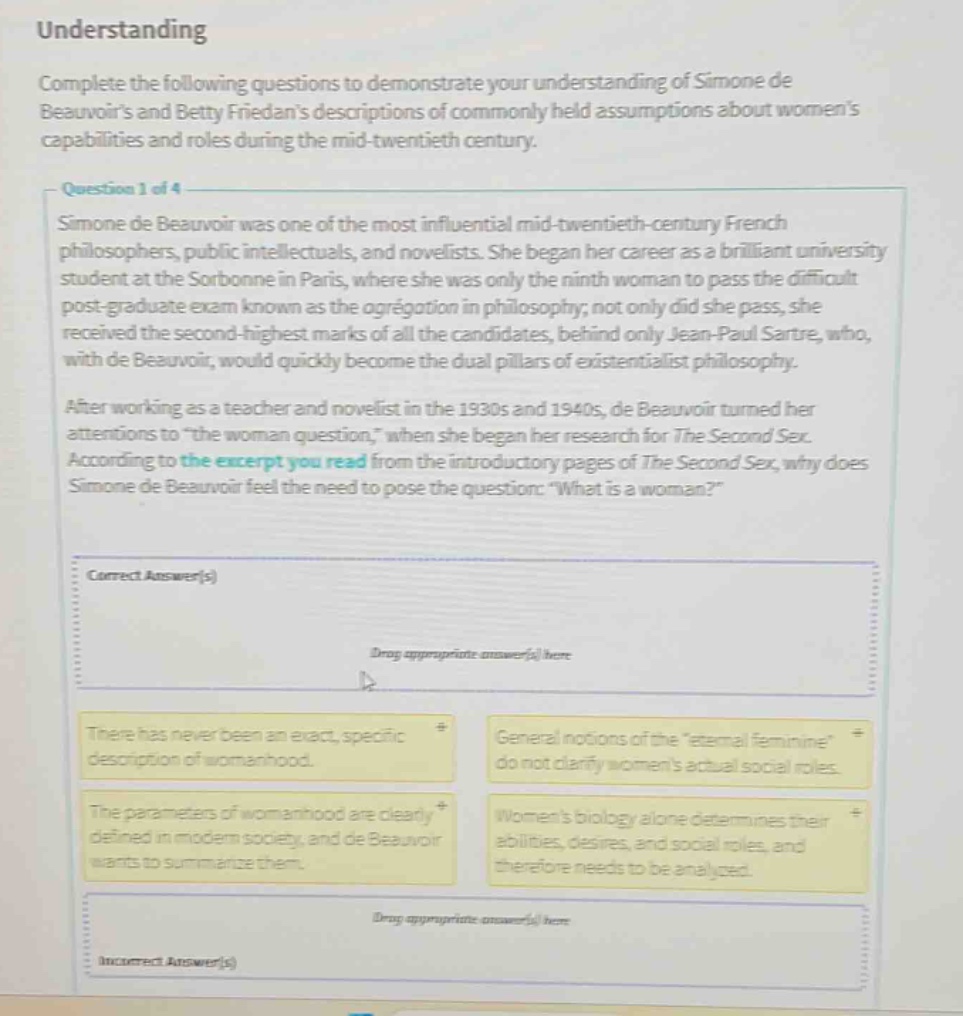
understanding\ncomplete the following questions to demonstrate your understanding of simone de beauvoirs and betty friedans descriptions of commonly held assumptions about womens capabilities and roles during the mid - twentieth century.\nquestion 1 of 4\nsimone de beauvoir was one of the most influential mid - twentieth - century french philosophers, public intellectuals, and novelists. she began her career as a brilliant university student at the sorbonne in paris, where she was only the ninth woman to pass the difficult post - graduate exam known as the agrégation in philosophy; not only did she pass, she received the second - highest marks of all the candidates, behind only jean - paul sartre, who, with de beauvoir, would quickly become the dual pillars of existentialist philosophy.\nafter working as a teacher and novelist in the 1930s and 1940s, de beauvoir turned her attentions to \the woman question,\ when she began her research for the second sex. according to the excerpt you read from the introductory pages of the second sex, why does simone de beauvoir feel the need to pose the question: \what is a woman?\\ncorrect answer(s)\ndrag appropriate answer(s) here\nthere has never been an exact, specific description of womanhood.\ngeneral notions of the eternal feminine do not clarify womens actual social roles.\nthe parameters of womanhood are clearly defined in modern society, and de beauvoir wants to summarize them.\nwomens biology alone determines their abilities, desires, and social roles, and therefore needs to be analysed.\ndrag appropriate answer(s) here\nincorrect answer(s)
Answer
Brief Explanations:
Simone de Beauvoir felt the need to pose "What is a woman?" because there was no exact description of woman - hood and general notions of the "eternal feminine" did not clarify women's actual social roles. The parameters of woman - hood were not clearly defined, and she did not believe that women's biology alone determined their abilities, desires, and social roles.
Answer:
There has never been an exact, specific description of womanhood., General notions of the "eternal feminine" do not clarify women's actual social roles.