unit 4 exam\n14 of 15\na scientist is trying to predict the eruption of a volcano that hasnt been studied…
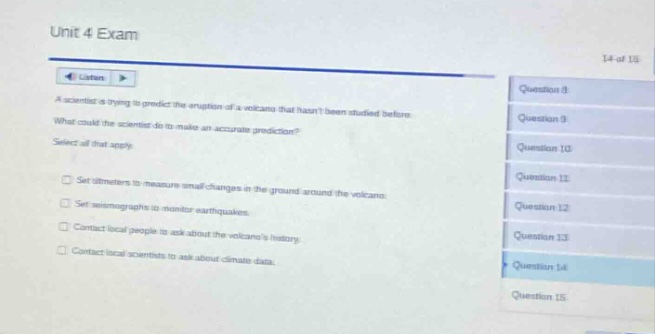
unit 4 exam\n14 of 15\na scientist is trying to predict the eruption of a volcano that hasnt been studied before. what could the scientist do to make an accurate prediction?\nselect all that apply.\nset tiltmeters to measure small - changes in the ground around the volcano.\nset seismographs to monitor earthquakes.\ncontact local people to ask about the volcanos history.\ncontact local scientists to ask about climate data.
Answer
Explanation:
Step1: Understand volcanic prediction
Monitoring ground - changes and earthquakes helps predict eruptions.
Step2: Analyze each option
- Set tiltmeters to measure small - changes in the ground around the volcano: Tiltmeters can detect ground deformation which is related to magma movement beneath the volcano, so this is a valid method.
- Set seismographs to monitor earthquakes: Earthquakes near a volcano can indicate magma movement and stress changes, so this is also valid.
- Contact local people to ask about the volcano's history: Local knowledge can provide information about past eruptions and patterns, which is useful for prediction.
- Contact local scientists to ask about climate data: Climate data has little direct relation to predicting a volcanic eruption.
Answer:
Set tiltmeters to measure small - changes in the ground around the volcano, Set seismographs to monitor earthquakes, Contact local people to ask about the volcano's history.