virginia state standards of learning science, math and technology practice tests start over start over view…
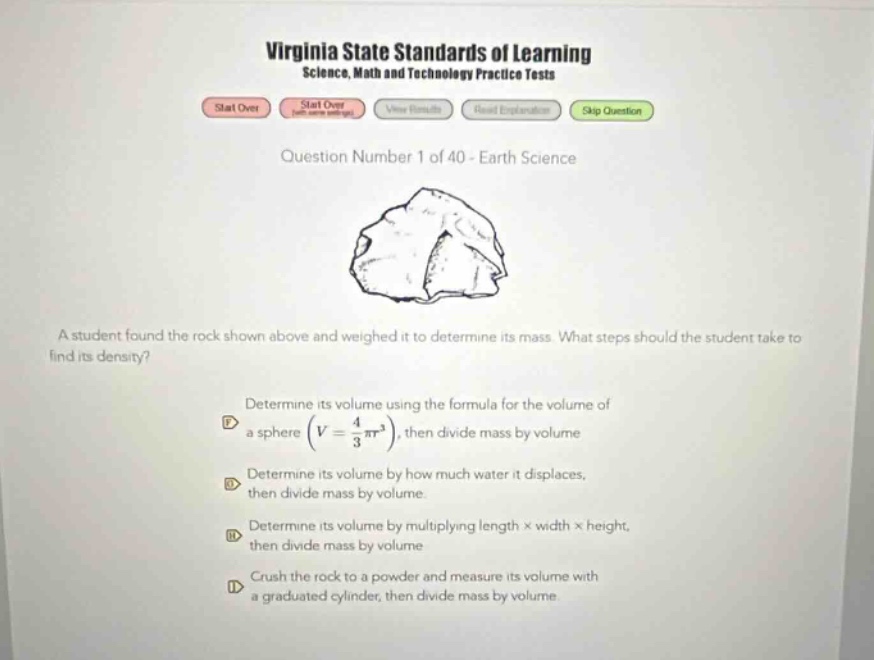
virginia state standards of learning science, math and technology practice tests start over start over view results read explanation skip question question number 1 of 40 - earth science a student found the rock shown above and weighed it to determine its mass. what steps should the student take to find its density? determine its volume using the formula for the volume of a sphere (v = 4/3 πr³), then divide mass by volume determine its volume by how much water it displaces, then divide mass by volume. determine its volume by multiplying length × width × height, then divide mass by volume crush the rock to a powder and measure its volume with a graduated cylinder, then divide mass by volume.
Answer
Explanation:
Step1: Recall density formula
Density $\rho=\frac{m}{V}$, where $m$ is mass and $V$ is volume.
Step2: Analyze volume - measurement methods for an irregular - shaped rock
An irregular - shaped rock's volume can be determined by the water - displacement method.
- Option A: Using the volume formula for a sphere is incorrect as the rock is irregular, not spherical.
- Option B: Determining volume by water displacement is a correct method for irregular - shaped objects. After getting the mass and volume in this way, density can be calculated as $\rho = \frac{m}{V}$.
- Option C: Multiplying length×width×height is for regular rectangular - shaped objects, not for irregular rocks.
- Option D: Crushing the rock changes its properties and is not a necessary or correct way to measure its volume for density calculation.
Answer:
B. Determine its volume by how much water it displaces, then divide mass by volume.