warm up 🔥 get locked in!\nbasketball sam, kendra, and tony are passing a basketball\nif sam is looking at…
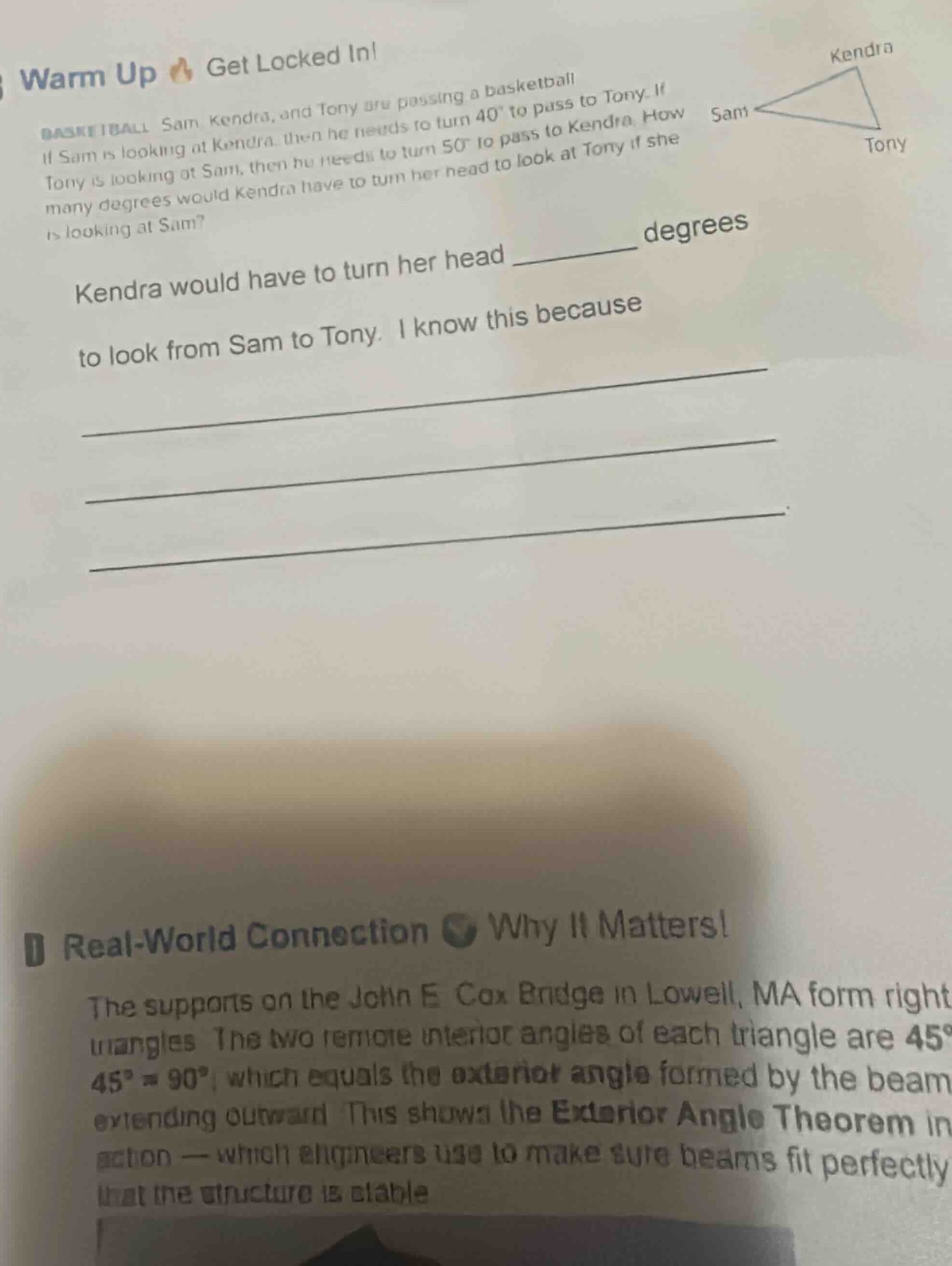
warm up 🔥 get locked in!\nbasketball sam, kendra, and tony are passing a basketball\nif sam is looking at kendra, then he needs to turn 40° to pass to tony. if\ntony is looking at sam, then he needs to turn 50° to pass to kendra. how\nmany degrees would kendra have to turn her head to look at tony if she\nis looking at sam?\nkendra would have to turn her head ______ degrees\nto look from sam to tony. i know this because\n_________________________________________\n_________________________________________\n_________________________________________.\nreal - world connection 🎯 why it matters!\nthe supports on the john e cox bridge in lowell, ma form right\ntriangles. the two remote interior angles of each triangle are 45°\n45° = 90°, which equals the exterior angle formed by the beam\nextending outward. this shows the exterior angle theorem in\naction — which engineers use to make sure beams fit perfectly\nthat the structure is stable
Answer
Explanation:
Step1: Recall triangle angle sum
The sum of angles in a triangle is (180^\circ). Let the angles at Sam, Tony, and Kendra be (S), (T), and (K) respectively. We know (S = 40^\circ) (Sam turns (40^\circ) to pass to Tony) and (T = 50^\circ) (Tony turns (50^\circ) to pass to Kendra).
Step2: Calculate Kendra's angle
Using the triangle angle sum formula (S + T + K = 180^\circ), substitute (S = 40^\circ) and (T = 50^\circ): (40^\circ+ 50^\circ+ K = 180^\circ) (90^\circ+ K = 180^\circ) Subtract (90^\circ) from both sides: (K = 180^\circ - 90^\circ=90^\circ)? Wait, no, wait. Wait, the angles at Sam: when Sam looks at Kendra, turning (40^\circ) to Tony means the angle at Sam between Kendra and Tony is (40^\circ). At Tony, looking at Sam, turning (50^\circ) to Kendra means the angle at Tony between Sam and Kendra is (50^\circ). So the triangle has angles: at Sam: (40^\circ), at Tony: (50^\circ), so at Kendra: (180 - 40 - 50 = 90^\circ)? Wait, no, maybe I misinterpret. Wait, the problem is about Kendra looking at Sam, then turning to Tony. So the angle at Kendra between Sam and Tony is what we need. So in triangle Sam - Kendra - Tony, the angles at Sam (between Kendra and Tony) is (40^\circ), at Tony (between Sam and Kendra) is (50^\circ), so angle at Kendra is (180 - 40 - 50 = 90^\circ)? Wait, no, let's re-express. Let’s denote:
-
When Sam is looking at Kendra, to pass to Tony, he turns (40^\circ): so (\angle SKT = 40^\circ) (angle at Sam between Kendra and Tony).
-
When Tony is looking at Sam, to pass to Kendra, he turns (50^\circ): so (\angle TSK = 50^\circ) (angle at Tony between Sam and Kendra).
Then in (\triangle SKT), the sum of angles is (180^\circ). So angle at Kendra ((\angle SKT)? Wait, no, vertices are S (Sam), K (Kendra), T (Tony). So angles:
-
(\angle at S): between K and T: (40^\circ)
-
(\angle at T): between S and K: (50^\circ)
-
(\angle at K): between S and T:?
So (\angle S + \angle T + \angle K = 180^\circ)
(40^\circ + 50^\circ + \angle K = 180^\circ)
(\angle K = 180 - 40 - 50 = 90^\circ). Wait, but that seems high. Wait, maybe the angles are: the angle Sam needs to turn from Kendra to Tony is (40^\circ), so that's the angle at Sam between K and T: (\angle KST = 40^\circ). The angle Tony needs to turn from Sam to Kendra is (50^\circ), so that's the angle at Tony between S and K: (\angle STK = 50^\circ). Then angle at K ((\angle SKT)) is (180 - 40 - 50 = 90^\circ). So Kendra, looking at Sam, needs to turn (90^\circ) to look at Tony. Wait, but maybe I made a mistake. Wait, let's check again. The sum of angles in a triangle is (180^\circ). So if two angles are (40^\circ) and (50^\circ), the third is (90^\circ). So Kendra's turn is (90^\circ).
Wait, no, maybe the angles are: Sam's angle: when he looks at Kendra, then turns (40^\circ) to Tony: so the angle between Kendra (his line of sight) and Tony (his line of sight) is (40^\circ), so that's the angle at Sam: (\angle KST = 40^\circ). Tony's angle: when he looks at Sam, turns (50^\circ) to Kendra: so the angle between Sam (his line of sight) and Kendra (his line of sight) is (50^\circ), so (\angle STK = 50^\circ). Then in triangle KST, angles sum to (180^\circ), so (\angle SKT = 180 - 40 - 50 = 90^\circ). So Kendra, looking at Sam (line of sight SK), needs to turn (90^\circ) to look at Tony (line of sight TK). So the answer is (90).
Answer:
90