water tank a water tank is shaped like the cone shown here. how much water can the tank hold? use 3.14 for…
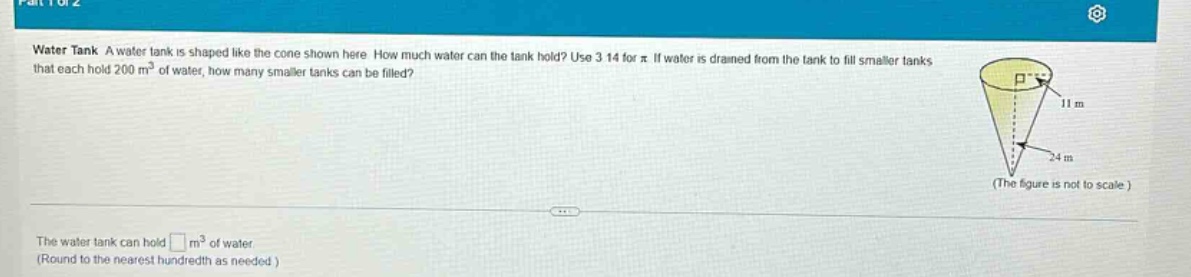
water tank a water tank is shaped like the cone shown here. how much water can the tank hold? use 3.14 for π. if water is drained from the tank to fill smaller tanks that each hold 200 m³ of water, how many smaller tanks can be filled? (the figure is not to scale.) the water tank can hold □ m³ of water. (round to the nearest hundredth as needed.)
Answer
Explanation:
Step1: Recall cone - volume formula
The volume formula of a cone is $V=\frac{1}{3}\pi r^{2}h$, where $r$ is the radius and $h$ is the height. Here, $r = 11$ m and $h=24$ m, and $\pi = 3.14$.
Step2: Calculate the volume of the cone - shaped tank
Substitute the values into the formula: [ \begin{align*} V&=\frac{1}{3}\times3.14\times11^{2}\times24\ &=\frac{1}{3}\times3.14\times121\times24\ &=3.14\times121\times8\ &=3.14\times968\ & = 3039.52 \end{align*} ]
Step3: Calculate the number of smaller tanks
To find the number of smaller tanks that can be filled, divide the volume of the large tank by the volume of each small tank. Each small tank has a volume of $200$ m³. So, $n=\frac{3039.52}{200}=15.1976\approx15$ (since we can't have a fraction of a tank).
Answer:
The water tank can hold $3039.52$ m³ of water. The number of smaller tanks that can be filled is $15$.