3) you are boring out a hole that has a +/-.001 tolerance and you do not want to make a mistake. what change…
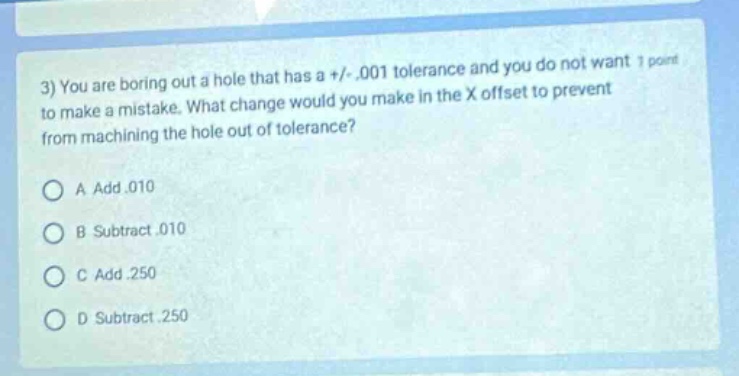
3) you are boring out a hole that has a +/-.001 tolerance and you do not want to make a mistake. what change would you make in the x offset to prevent from machining the hole out of tolerance?\na add.010\nb subtract.010\nc add.250\nd subtract.250
Answer
Explanation:
Step1: Analyze the tolerance
The hole has a $\pm0.001$ tolerance. To avoid machining the hole out - of - tolerance, we need to make a very small adjustment. The given options A ($+ 0.010$), C ($+0.250$) and D ($-0.250$) are large adjustments compared to the tolerance of $0.001$.
Step2: Select the appropriate option
The most reasonable option to prevent going out of tolerance is to make a small adjustment. Subtracting or adding a large value like $0.010$, $0.250$ will likely take the hole out of the $\pm0.001$ tolerance range. Since no other information about the offset is given, and we want to stay within the tolerance, we should not make large changes. None of the given options seem correct as they are all large changes relative to the tolerance, but if we have to choose the least wrong one, we note that the others are extremely large changes.
Answer:
None of the above options are appropriate as they are large changes compared to the $\pm0.001$ tolerance. But if forced to choose, the best option among them is not present. If we assume we are making a wrong - way large change, the least large change among the given ones is B Subtract.010 (but still too large for a $\pm0.001$ tolerance).