younger rock layers exist ______________, while older rock layers exist 2 point\ndeep underground / at the…
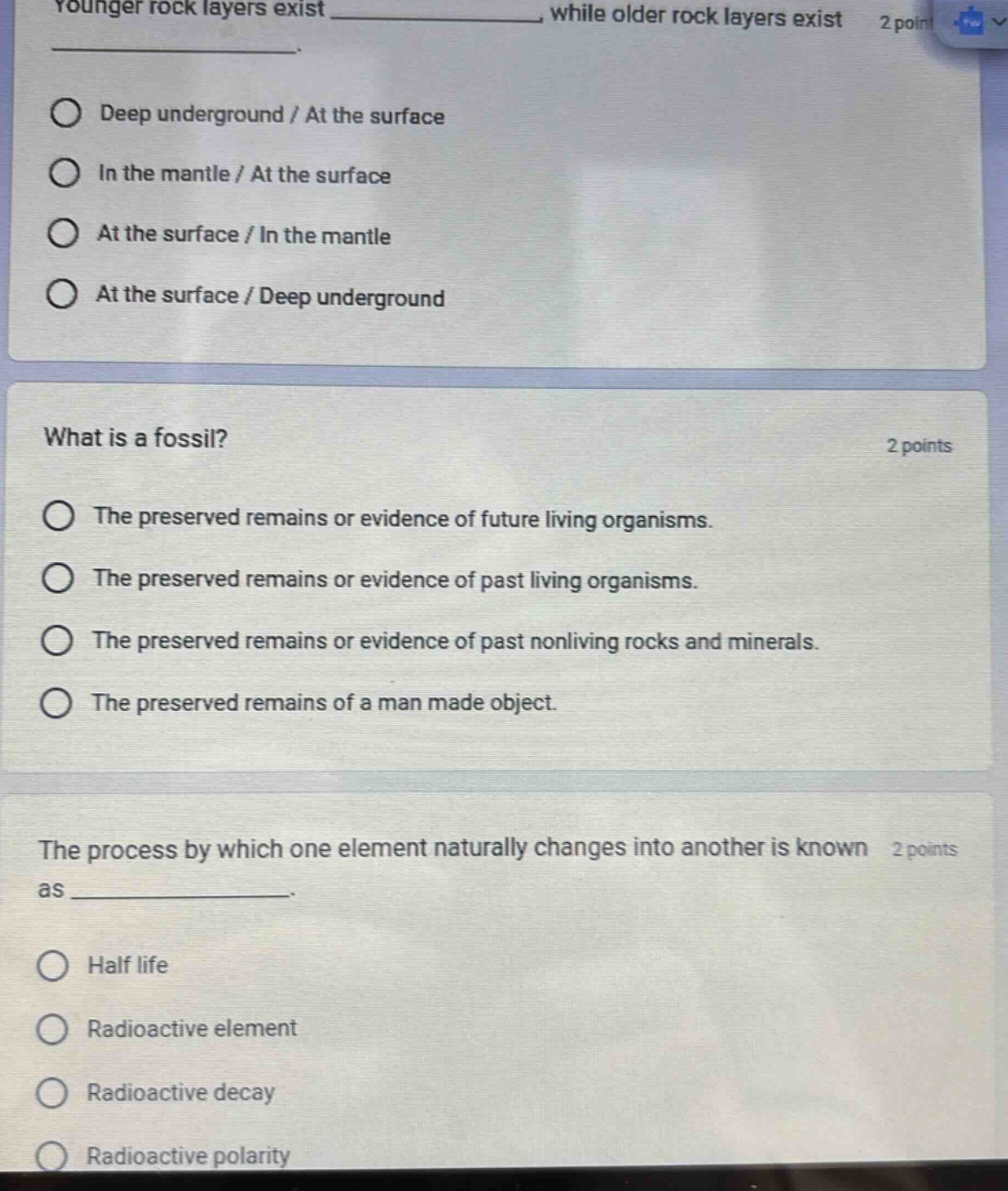
younger rock layers exist ______________, while older rock layers exist 2 point\ndeep underground / at the surface\nin the mantle / at the surface\nat the surface / in the mantle\nat the surface / deep underground\nwhat is a fossil? 2 points\nthe preserved remains or evidence of future living organisms.\nthe preserved remains or evidence of past living organisms.\nthe preserved remains or evidence of past nonliving rocks and minerals.\nthe preserved remains of a man made object.\nthe process by which one element naturally changes into another is known 2 points as ______________.\nhalf life\nradioactive element\nradioactive decay\nradioactive polarity
Answer
Answer:
- D. At the surface / Deep underground
- B. The preserved remains or evidence of past living organisms.
- C. Radioactive decay
Brief Explanations:
- Newer rock layers form on top, so are at the surface; older ones are deeper.
- Fossils are remains of past - living things.
- Radioactive decay is the process of one element changing into another naturally.