10. the potential energy of an object held above the ground depends on its mass, gravity, and its:\na. speed…
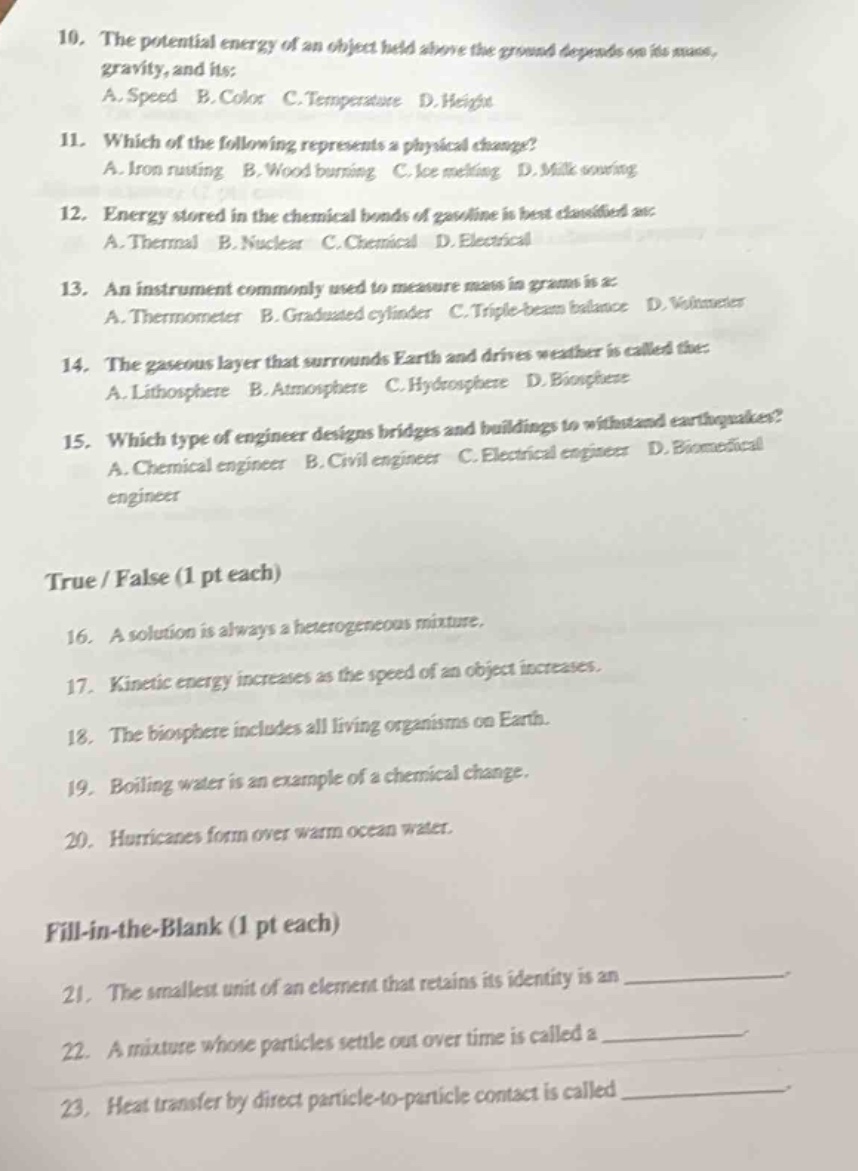
10. the potential energy of an object held above the ground depends on its mass, gravity, and its:\na. speed b. color c. temperature d. height\n11. which of the following represents a physical change?\na. iron rusting b. wood burning c. ice melting d. milk souring\n12. energy stored in the chemical bonds of gasoline is best classified as:\na. thermal b. nuclear c. chemical d. electrical\n13. an instrument commonly used to measure mass in grams is a:\na. thermometer b. graduated cylinder c. triple - beam balance d. voltmeter\n14. the gaseous layer that surrounds earth and drives weather is called the:\na. lithosphere b. atmosphere c. hydrosphere d. biosphere\n15. which type of engineer designs bridges and buildings to withstand earthquakes?\na. chemical engineer b. civil engineer c. electrical engineer d. biomedical engineer\n\ntrue / false (1 pt each)\n16. a solution is always a heterogeneous mixture.\n17. kinetic energy increases as the speed of an object increases.\n18. the biosphere includes all living organisms on earth.\n19. boiling water is an example of a chemical change.\n20. hurricanes form over warm ocean water.\n\nfill - in - the - blank (1 pt each)\n21. the smallest unit of an element that retains its identity is an \n22. a mixture whose particles settle out over time is called a \n23. heat transfer by direct particle - to - particle contact is called
Answer
Brief Explanations:
- The potential - energy formula for an object above the ground is $PE = mgh$ where $m$ is mass, $g$ is gravity, and $h$ is height. So it depends on height.
- A physical change is a change in the state or form of a substance without changing its chemical composition. Ice melting is a physical change as it changes from solid to liquid without a chemical reaction.
- Energy stored in chemical bonds is chemical energy. Gasoline has chemical energy stored in its bonds.
- A triple - beam balance is used to measure mass in grams.
- The atmosphere is the gaseous layer that surrounds Earth and drives weather.
- Civil engineers design bridges and buildings to withstand earthquakes.
- A solution is a homogeneous mixture, not heterogeneous.
- Kinetic energy is given by $KE=\frac{1}{2}mv^{2}$, so it increases as speed increases.
- The biosphere includes all living organisms on Earth.
- Boiling water is a physical change as it changes from liquid to gas without a chemical reaction.
- Hurricanes form over warm ocean water.
- The smallest unit of an element that retains its identity is an atom.
- A mixture whose particles settle out over time is called a suspension.
- Heat transfer by direct particle - to - particle contact is called conduction.
Answer:
- D. Height
- C. Ice melting
- C. Chemical
- C. Triple - beam balance
- B. Atmosphere
- B. Civil engineer
- False
- True
- True
- False
- True
- atom
- suspension
- conduction