16. during a lunar eclipse\na. the moon lies between the earth and sun\nb. the sun lies between the moon and…
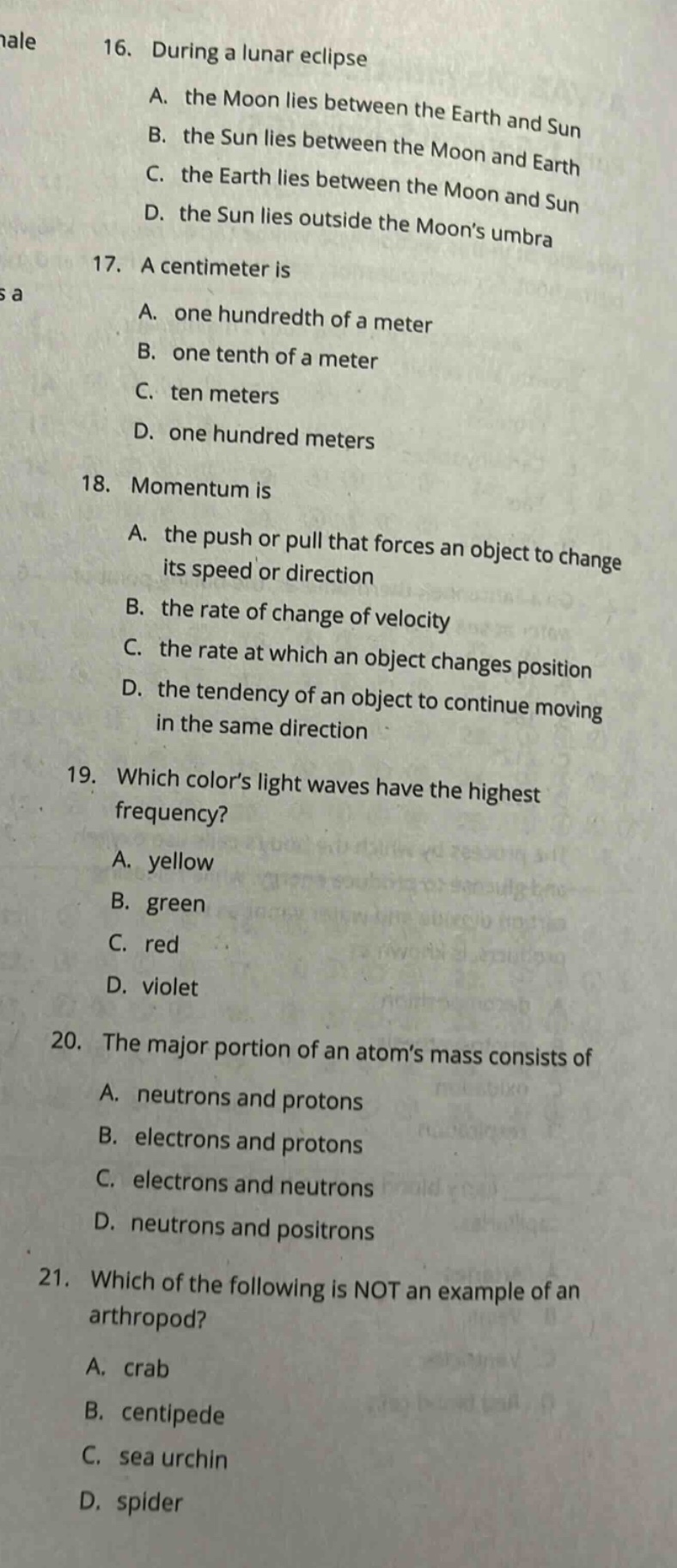
16. during a lunar eclipse\na. the moon lies between the earth and sun\nb. the sun lies between the moon and earth\nc. the earth lies between the moon and sun\nd. the sun lies outside the moons umbra\n17. a centimeter is\na. one hundredth of a meter\nb. one tenth of a meter\nc. ten meters\nd. one hundred meters\n18. momentum is\na. the push or pull that forces an object to change its speed or direction\nb. the rate of change of velocity\nc. the rate at which an object changes position\nd. the tendency of an object to continue moving in the same direction\n19. which colors light waves have the highest frequency?\na. yellow\nb. green\nc. red\nd. violet\n20. the major portion of an atoms mass consists of\na. neutrons and protons\nb. electrons and protons\nc. electrons and neutrons\nd. neutrons and positrons\n21. which of the following is not an example of an arthropod?\na. crab\nb. centipede\nc. sea urchin\nd. spider
Answer
Answer:
- C. the Earth lies between the Moon and Sun
- A. one hundredth of a meter
- D. the tendency of an object to continue moving in the same direction
- D. violet
- A. neutrons and protons
- C. sea urchin
Brief Explanations:
- In a lunar - eclipse, Earth blocks sunlight from reaching the Moon.
- By definition, 1 centimeter = 0.01 meters or one - hundredth of a meter.
- Momentum is mass times velocity, related to an object's motion tendency.
- Violet light has the shortest wavelength and highest frequency in visible light.
- Protons and neutrons in the nucleus make up most of an atom's mass.
- Sea urchins are echinoderms, not arthropods which include crabs, centipedes, and spiders.